5 Startup App Ideas Solving Problems in 2026
 Katarzyna Górecka
•
•
11 min read
Katarzyna Górecka
•
•
11 min read
Explore innovative startup app ideas solving problems in 2026. Discover how these solutions can change industries. Dive into the future with us today!
Most apps don’t fail because the idea is bad. They fail because they solve problems nobody actually has. The best startup app ideas solving problems in 2026 flip that around – they address friction people already pay to avoid, in categories with real money and thin competition. If you’re an entrepreneur hunting for your next build, this year the winners cluster in five spaces: AI-powered financial tools, personalized health apps, niche community platforms, hyperlocal business automation, and adaptive learning.
Below are five concrete directions. Each one starts with a problem worth solving. For every idea, you’ll get who it’s for, how it makes money, and why 2026 is the right window. The mobile app market was worth USD 252.89 billion in 2023 and it keeps climbing – the demand is there. The trick is picking a problem sharp enough that people notice when it’s gone.
Why 2026 Is a Strong Year for Problem-Solving Apps
The mobile app market isn’t just large. That growth doesn’t spread evenly. It pools in a handful of categories where the pain is sharp and the tools are finally cheap enough to build.
A minimum viable product, or MVP, is the simplest version of an app that still solves the core problem for real users. In 2026, AI has pushed the cost of building one way down. A single founder can now ship features that needed a full team two years ago. Code assistants, model APIs, no-code builders – the gap between an idea and a working prototype is measured in days now, not quarters.
That changes the math on startup app ideas solving problems in 2026. You no longer need six figures to test whether people want your solution. You need a clear problem, a narrow audience, and a monetization plan that fits how people already spend.
Here’s what makes a category worth entering this year:
- Real spending already exists – people pay for the manual version of the problem
- AI removes grunt work – forecasting, personalization, and summarizing were expensive, now they’re API calls
- The niche is too small for big players – large companies ignore niche opportunities that can’t scale to millions overnight
- Recurring value – the app helps weekly or daily, not once
The categories below all pass that test. From our work connecting entrepreneurs across borders on Mybzz.com, we see the same pattern repeat. The founders who win aren’t chasing the flashiest tech. They’re chasing a problem they can describe in one sentence.
1. AI-Powered Personal Finance and Fintech Tools
Money stress is universal. Money tools are still clunky. That gap is the whole opportunity. Fintech stays one of the strongest categories for startup app ideas solving problems in 2026, because people trust software with their finances more every year – and they’ll pay for anything that saves or grows their money.
The specific problem worth solving: most people have no idea where their money leaks. An AI-driven app can read spending patterns, flag subscriptions the user forgot about, predict cash-flow gaps before they happen, and suggest concrete moves. This isn’t a budgeting spreadsheet with a nicer skin. It’s a tool that acts.
- Core feature: AI categorizes transactions and predicts next month’s shortfall
- Differentiator: proactive nudges ("you’ll be $200 short on the 28th – here’s why")
- Niche angle: freelancers and gig workers whose income is irregular and underserved
Who it’s for: freelancers, small-business owners, and anyone with variable income who dreads opening their bank app.
How it makes money: subscriptions work best here. A freemium tier hooks users with basic tracking, then the paid tier unlocks forecasting and automated savings. Fintech users accept subscriptions because the app pays for itself.
Why 2026 favors this build: forecasting used to require a data science team. Now it’s a well-priced model call. One founder can ship a credible fintech MVP and validate it with a few hundred users before spending real capital.
2. Personalized Health and Wellness Apps
Generic fitness apps have hit a ceiling. Everyone downloads them. Most people delete them by February. The problem isn’t motivation – it’s that a plan built for "everyone" fits no one. Health and wellness stays a high-growth category precisely because personalization finally works at scale.
Industry sources point out that AI-driven apps can build personalized health plans by tracking biometrics and lifestyle in real time. That’s the unlock. Instead of a static 12-week program, the app adjusts today’s workout based on last night’s sleep, this week’s stress, and how the user actually recovered.
Concrete directions inside this space:
- Adaptive nutrition planning that reworks meals around what’s in the fridge and the user’s blood-sugar response
- Recovery-first fitness that scales intensity to sleep and heart-rate data
- Menopause, chronic-condition, or new-parent wellness – narrow audiences the big apps ignore
Who it’s for: people who’ve bounced off generic apps and want something that treats them as an individual.
Cost model: freemium fits naturally. Free habit tracking, paid personalization. Health is a category where people spend without much resistance once they feel progress.
One caution on the health angle. Anything touching medical decisions carries real risk. Keep the app in wellness and habit territory, and route users toward a doctor for anything clinical. That boundary protects both your users and your business.
Meet entrepreneurs who think like you
MYBZZ — the networking app for business. Free on iOS & Android.
3. Niche Community and Marketplace Apps
The most defensible startup app ideas solving problems in 2026 aren’t broad – they’re deliberately narrow. Big platforms serve billions and, by design, serve nobody’s specific problem well. That leaves whole communities underserved. A niche marketplace is a focused app that connects buyers, sellers, or peers inside a tightly defined group.
Two examples show the pattern: halal food discovery and expat relocation both have genuine demand and low competition. Someone who just moved to a new country doesn’t want a general review app. They want housing, banking, schools, and community answers built for their exact situation. These are the niche opportunities big players overlook precisely because the audience feels too small to bother with.
| App direction | Underserved group | Why it works |
|---|---|---|
| Expat relocation hub | People moving abroad | Fragmented info, real urgency, will pay |
| Halal / dietary discovery | Specific dietary needs | Big apps don’t filter well enough |
| Trade-specific marketplace | Niche professionals | Peers can’t find each other easily |
| Local hobby community | Enthusiasts by city | Facebook groups are too messy |
Who it’s for: founders who are part of a community and feel its friction firsthand. That insider view is your unfair advantage.
How it makes money: transaction fees on the marketplace, premium memberships, or paid listings.
This is close to what we do at Mybzz.com – matching entrepreneurs with the right partners and investors worldwide instead of dumping them into one giant feed. The lesson transfers to any niche: precise matching beats broad reach. If you’re weighing broader networking builds too, our roundup of 10 best sites like linkedin networking alternatives for 2026 breaks down where the real gaps sit.
4. Hyperlocal Business Automation Apps
Small local businesses run on guesswork and duct tape. The bakery owner over-orders flour. The salon has empty Tuesdays. The café can’t predict a rush. Each mistake costs money. Automating those decisions is a wide-open lane for SaaS web apps and mobile tools alike.
The problem is concrete and the value is measurable. AI can optimize local operations through demand forecasting and dynamic pricing. An app that tells a restaurant how much to prep tomorrow, or nudges a gym to discount off-peak slots, pays for itself in weeks. Owners don’t care about the tech. They care that they wasted less and earned more.
Where the openings are:
- Inventory forecasting for shops that currently order on gut feel
- Dynamic scheduling and pricing for service businesses with idle capacity
- Automated review and booking management so owners stop losing evenings to admin
Who it’s for: independent local businesses – the ones too small for enterprise software but drowning in the same problems.
Pricing: flat monthly SaaS subscription, kept low enough that a single saved order justifies it.
From our experience talking to owner-operators, the winning pitch is never "AI-powered." It’s "you’ll throw away less stock." Sell the outcome, not the algorithm. This category also pairs well with broader small-business planning – our guide to top small business ideas 2026 start an online business covers adjacent opportunities worth scanning before you commit.
5. Adaptive Microlearning and Skills Apps
People want to learn. They just don’t have the hour. That’s the whole problem microlearning solves. Microlearning means teaching in short, focused bursts – a few minutes at a time – instead of long sessions. It fits real life, which is exactly why it converts.
The 2026 upgrade is adaptation. On-demand microlearning apps can adapt content in real time to user progress, so someone struggling with a concept gets more reps while someone breezing through moves on. Static courses can’t do that. Adaptive ones keep people coming back, and retention is where subscription revenue lives.
Strong directions:
- Professional micro-skills – negotiation, spreadsheets, sales – delivered in five-minute lessons
- Language practice that adjusts difficulty to yesterday’s mistakes
- Compliance or certification prep for specific industries
Who it’s for: busy professionals and students who abandon long courses but will do five minutes daily.
How it makes money: subscription is the natural fit, with a freemium tier to prove value first. The app should show progress fast, because the paid conversion happens when the user feels they’re actually improving.
Unique app ideas for students live here too. A tool that turns any uploaded PDF into a five-minute daily quiz would solve a problem millions have. For a wider set of directions, we collected more in our Mobile app ideas for 2026 startup app idea guide.
How to Validate Before You Build
Picking the idea is the easy part. The graveyard is full of apps that solved imaginary problems. Before writing a line of code, prove the problem is real and painful. Validation means confirming that people want your solution enough to use or pay for it – ideally before you build the full product.
Here’s a practical order that works:
- Write the problem in one sentence. If you can’t, it isn’t sharp enough.
- Find ten people who have it and talk to them – not friends, actual strangers in the niche.
- Build the thinnest MVP that solves only the core problem.
- Charge, or ask for a pre-commitment, early. Interest is cheap; a card on file isn’t.
- Watch what users do, not what they say.
Most people won’t pay upfront. Your freemium or subscription model has to earn the upgrade by delivering real value first. Growth compounds when the free tier is genuinely useful and the paid tier is genuinely worth it. If you want tactical moves for that stage, our 15 growth hacking ideas examples strategies to hack your growth walks through how to pull early users in without a big budget.
FAQ
What are the best startup app ideas solving problems in 2026?
The strongest categories are AI-powered fintech, personalized health and wellness, niche community marketplaces, hyperlocal business automation, and adaptive microlearning. Each targets a real, recurring problem with existing spending and thin competition. The best pick is one where you personally understand the pain, because that insight guides every product decision.
Do I need a big budget to build a startup app in 2026?
No. AI-powered tools have cut the cost of building a functional MVP dramatically, so a single founder can now ship and test features that once needed a full team. Start with the thinnest version that solves the core problem, validate with real users, and only invest heavily once demand is proven.
How do these apps actually make money?
Most rely on subscription or freemium models. A free tier proves value and pulls users in, then a paid tier unlocks the features people will pay for – forecasting, personalization, or automation.
Which app idea has the lowest competition?
Niche opportunities tend to have the least competition because large companies ignore audiences that can’t scale to millions fast. Examples like expat relocation and halal food discovery have real demand with few serious players. Pick a community you belong to – your insider knowledge is competition big platforms can’t copy.
How do I know if my app idea is worth building?
Validate before you build. Write the problem in one clear sentence, talk to ten real people who have it, ship a minimal MVP, and ask for payment or a pre-commitment early. What users do matters far more than what they say they’ll do.
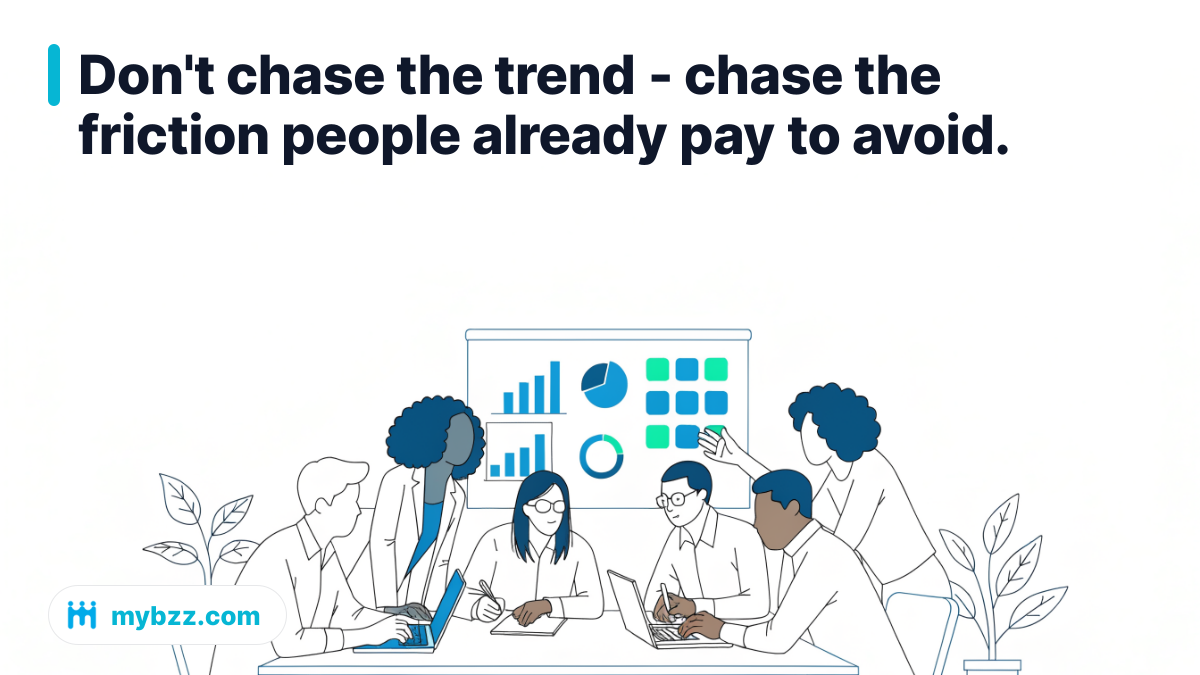
The pattern across all five is the same: sharp problem, narrow audience, honest monetization. Don’t chase the trend – chase the friction. When you focus on startup app ideas solving problems in 2026, the moment you can describe the problem in one sentence and name ten people who have it, you’re further along than most founders ever get. Your next step is simple: pick one idea from this list, find those ten people this week, and ask them what they’d pay to make the problem disappear. That conversation will teach you more than a month of planning. And if part of your build involves connecting with partners, investors, or early adopters across borders, that’s exactly the problem we help solve at Mybzz.com.
Rate this article
Ready to grow your business?
Download MYBZZ for free and join thousands of entrepreneurs.
Download the app for free

Related articles
How to Register Your Company Step by Step | USA
07.11.2025 · 6 min
Creating a Basic Logo on a Budget
03.11.2025 · 8 min
How to Expand Your Business Internationally
22.10.2025 · 6 min