How does AI matching work for business connections?
 Katarzyna Górecka
•
•
6 min read
Katarzyna Górecka
•
•
6 min read
Understand how AI matching works to connect you with relevant business partners, streamlining your networking efforts. Join us at Mybzz today!
Some networking apps introduce you to exactly the right person. Others just flood your inbox with profiles that go nowhere. The difference is AI matching: a process that converts your professional information into structured data, uses language models to understand what you actually mean, and scores compatibility to connect you with the right people. Forget keyword filters and endless scrolling. The system reads your goals, industry, and business intent, then ranks contacts by fit. For entrepreneurs hunting for co-founders, investors, or partners, that means fewer dead-end messages and more conversations that go somewhere. Here’s how the technology works, why algorithms beat manual search, and where it’s headed in 2026.
How does AI matching work step by step?
AI matching follows a clear sequence: it turns raw profile text into data, interprets meaning, scores fit, then surfaces the best candidates.
- Data conversion. Your profile, industry, and goals get broken into structured signals. "Looking for a technical co-founder for a fintech app" becomes tagged attributes: role sought, sector, stage.
- Meaning analysis. Language models read context, not just keywords. They understand that "SaaS founder" and "software subscription business owner" describe the same thing.
- Ranking and surfacing. Highest-scoring matches appear first, so you spend time on people who make sense.
Modern algorithms have left simple keyword filters far behind. They run on transformer-based models that read language the way a person does, weighing nuance and adapting as more data comes in.
AI matching does not decide who is objectively "best" – it estimates who is most relevant to your specific business goals.
How is AI matching different from keyword search?
Keyword search looks for exact word overlap; AI matching understands context and intent. A filter searching "marketing" misses someone who wrote "growth strategy" or "customer acquisition," even though they may be a perfect fit. AI-driven systems use probabilistic and contextual analysis, so they catch relevant people traditional searches skip.
This matters for two reasons. First, it widens your pool. Context-aware matching surfaces people you’d never find by typing search terms.
On our platform, Mybzz, AI reads profiles, industries, and goals to build matches that reflect real business intent rather than surface-level word matches. That’s the gap between guessing and being introduced.
Meet entrepreneurs who think like you
MYBZZ — the networking app for business. Free on iOS & Android.
Why do algorithms connect people better than manual search?
Algorithms compare far more variables, far faster, and improve over time. A person browsing profiles can hold only a few criteria in mind. A matching system weighs role, sector, stage, location intent, and goal alignment all at once, across a global pool.
Then there’s the learning factor. These systems use machine learning to keep improving match quality, adapting to who actually connects and who ignores each other. The more the platform is used, the sharper the recommendations.
Consider a real example. The owner of a renovation company from the Tri-City area told us he’d attended business breakfasts for six months and gained nothing. On our platform, in his second week, he matched with an interior architect who needed a permanent team. They’ve worked together ever since. That’s the difference between showing up at networking events and hoping, versus being matched on shared intent from the start.
What data does AI matching actually use?
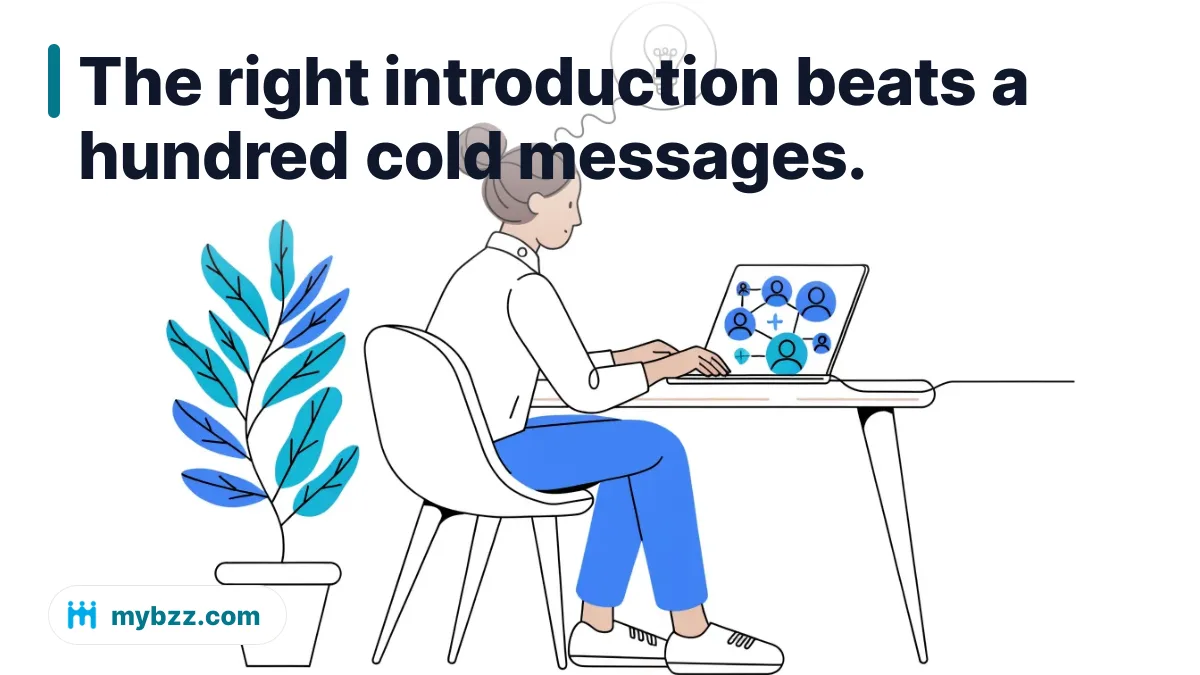
AI matching relies on the signals you provide and the behavior it observes. It reads what you tell it and how you engage. Match quality depends heavily on how completely you fill out your profile.
Main inputs a business matching system evaluates:
- Stated goals – co-founder, investor, B2B partner, or a project to fund?
- Industry and sector – fintech, manufacturing, creative services, and so on.
- Experience and stage – early idea, revenue-generating, scaling.
- Business intent – the "why," which language models parse from your description.
- Geographic reach – local partners or connections across the more than 50 countries our community spans.
The clearer your inputs, the more accurate the scoring. Vague profiles produce vague matches. Think of your profile as the brief the algorithm works from. If you’re comparing tools, our breakdown of the best business networking apps covers how platforms handle this data.
What are the limits and ethics of AI matching?
AI matching estimates relevance – it does not guarantee a perfect partner. The system ranks probability of fit, not certainty. A high score is a strong starting point for a conversation, not a verdict on someone’s reliability.
A few honest limits:
- It reflects the data it’s given. Thin or misleading profiles skew results.
- It suggests, you decide. Verifying track record, references, and terms stays your job.
- Bias needs watching. Any system trained on patterns can over-favor certain profiles, which is why quality platforms tune for balanced connections rather than raw volume.
The honest approach is being clear about what the algorithm does and doesn’t do. We use AI to cut noise and start real conversations from mutual intent – not to replace your judgment. See Mybzz vs meetup and Mybzz vs xing for direct comparisons on matching depth versus reach.
FAQ
Is AI matching accurate?
It’s accurate at estimating relevance, not certainty. Modern algorithms reach high fit-scoring precision, but they rank probability of a good match rather than proving one. Treat a top match as a strong lead, then verify fit yourself before committing.
Do I need a paid plan for AI matching to work?
No. Our free plan lets you explore and connect with AI matching at no cost and with no time limit. VIP Lifetime Access, a one-time web payment, unlocks advanced search and broader global connections.
How is AI matching different from LinkedIn?
Large professional networks are built for reach and profile verification, so people use them to check backgrounds. AI matching platforms for entrepreneurs start conversations from mutual intent – the algorithm proposes who fits your goals rather than leaving you to search. Many people use both: one to be matched, the other to confirm.
If you’ve been collecting business cards and getting nowhere, the fix isn’t more effort – it’s better targeting. Set up a specific, honest profile, state exactly what you’re building and what you need, and let the matching do the filtering. The renovation owner who matched with the right partner in two weeks didn’t work harder; he showed up where the algorithm could read his intent. Create a free profile, write your goal clearly, and see who the system puts in front of you this week.
Rate this article
Ready to grow your business?
Download MYBZZ for free and join thousands of entrepreneurs.
Download the app for free

Related articles
Effective long-term networking strategies for sustained growth
21.09.2026 · 7 min
What makes AI-based networking platforms a game changer?
20.09.2026 · 8 min
Networking strategies for remote workers: 5 essential tips
18.09.2026 · 8 min