Business conversations: 7 networking app openers for replies
 Katarzyna Górecka
•
•
8 min read
Katarzyna Górecka
•
•
8 min read
Enhance your business conversations with seven app openers that boost reply rates. Start making impactful connections today with Mybzz.
That’s roughly how long someone spends deciding whether to reply to a cold networking message before moving on. Business conversations that lead to real partnerships almost never start with "Hi, I’d love to connect." They start with an opener that gives the other person a reason to type back. The strongest openers do three things at once: they show you read the profile, they name something specific, and they make replying easy.
Below are seven openers that consistently earn replies, plus why each one works. These aren’t scripts to copy word for word – they’re patterns you fill with detail from the actual person in front of you. Get the first line right and the rest of the conversation tends to take care of itself.
What makes a business conversation opener actually get a reply
A business conversation is a professional exchange aimed at a concrete outcome – a partnership, an introduction, a deal, a hire. The opener is the first move, and it either earns attention or gets ignored. Most cold messages fail for the same reason: they’re about the sender, not the recipient.
A reply-worthy opener has four traits. It’s specific (references something only their profile shows). It’s low-effort to answer (one clear question, not five). It carries no immediate ask (you’re not requesting a favor in message one). And it has relevance – a genuine reason you two should talk.
Here’s the uncomfortable math. At a large event, most people around you simply aren’t a fit. We saw this at Web Summit 2025, which had over 70,000 participants. We ran more than 150 conversations there and identified 30 with real business potential – roughly one in five. Openers are how you skip the other four. The better your first line filters for fit, the fewer wasted conversations you have. The point is to build relationships that go somewhere, not to collect business cards that end up in a drawer.
The seven openers that earn replies
Each opener solves a different starting situation. Use the one that matches your reason for reaching out.
-
The specific reference. Name one concrete thing from their profile or recent activity. "Saw you scaled your logistics startup into three new markets last year – what surprised you most about the second market?" It proves you looked, and invites a story rather than a yes/no.
-
The shared context. Anchor on something you have in common. "We both spoke at the same fintech track – the summary got shared around my team. Curious how the audience reacted to your pricing point." Common ground lowers the guard.
-
The useful observation. Offer a small insight before asking anything. "Your onboarding flow is clean – one thing that helped us cut drop-off was moving the payment step later. Happy to share the data if useful." You give first.
-
The direct-intent line. State plainly why you’re here. "I’m looking for a co-founder with a B2B sales background – your track record fits exactly what I’m building. Open to a 15-minute call?" Clarity beats vagueness when both sides have a goal.
-
The one-question opener. Ask a single sharp question tied to their expertise. "How are you handling churn in the current market?"
-
The mutual-goal frame. Connect their objective to yours. "You mentioned expanding into Poland – that’s our home market. I might be able to shortcut a few introductions." Reciprocity built in.
-
The warm-referral mention. Borrow trust from a shared connection. "Anna from the growth community suggested we talk – she said your view on retention would help me a lot." Trust transfers when the name is real.
Comparing the seven openers at a glance
| Opener | Best when | What it earns |
|---|---|---|
| Specific reference | You’ve read their profile | A detailed reply |
| Shared context | You have common ground | Quick rapport |
| Useful observation | You can offer value first | Goodwill and trust |
| Direct-intent line | Both sides have clear goals | A fast yes or no |
| One-question opener | They have niche expertise | An expert answer |
| Mutual-goal frame | Your goals overlap | A reciprocal offer |
| Warm-referral mention | You share a real contact | Borrowed trust |
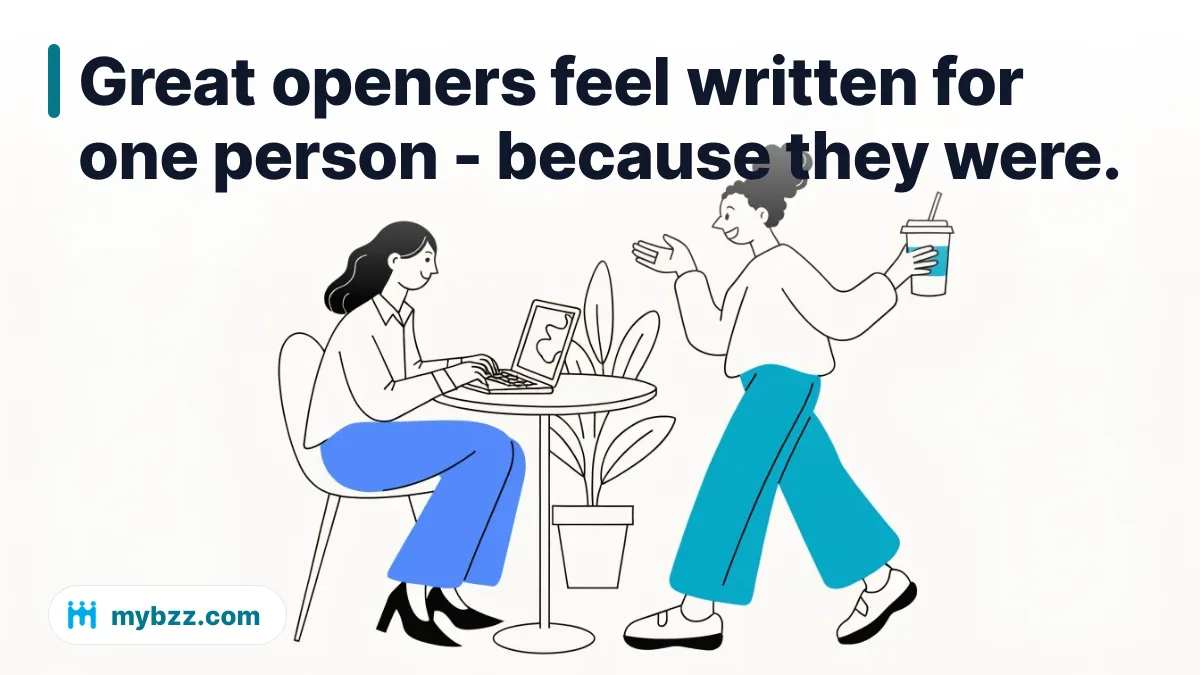
Notice what none of them do: none lead with a favor, and none are copy-paste generic. The opener that gets ignored is the one sent to fifty people at once. The one that gets a reply feels written for one person, because it was.
Meet entrepreneurs who think like you
MYBZZ — the networking app for business. Free on iOS & Android.
Culture changes what "good" sounds like
The same opener lands differently across markets. Directness that reads as confident in the United States can read as pushy in parts of Northern Europe or Japan. In Germany or the Netherlands, a straight direct-intent line often works well – people appreciate skipping the warm-up. In much of Asia and the Middle East, leading with rapport and small talk before stating your goal signals respect.
A few adjustments that travel well:
- In high-context cultures, spend the first message building relationship, not pitching.
- In low-context, results-driven markets, get to your point by sentence two.
- Watch formality with titles and last names – defaulting to first names too early can misfire.
- Time zones matter more than people admit; a message sent at their 9 a.m. beats one buried overnight.
When unsure of the norm, lean slightly more formal and let them set the pace. It’s easier to loosen up than to walk back a message that felt too familiar.
Where the opener actually happens: apps built for it
An opener only works if you’re in front of the right person. That’s the part most people get wrong – they perfect the message and send it into the void. Meeting the right contact is a filtering problem, and this is exactly what our app was built to solve. Mybzz uses AI to match entrepreneurs by goals, experience, and intent, so your opener lands with someone who has a reason to reply.
Because both sides opted in around mutual intent, you skip the cold-outreach lottery. If you want to see how we stack up against other options on the market, we tested and ranked the 8 Best Business Networking Apps in 2026.
"The entire value of a conference lies in filtering – and if technology does that filtering before you leave home, you start every conversation warm."
But the goal isn’t a date – it’s a working relationship. For a deeper breakdown, see our guide to tinder for business. We built a business partner matching app precisely so the opener isn’t your hardest problem.
Turning a first reply into a real relationship
An opener that earns a reply is the start, not the finish. Relationship building is the discipline of following up without becoming annoying. The second message matters as much as the first – it either deepens the thread or lets it die. The strongest professional relationships often trace back to a single well-timed follow-up rather than the opener itself.
Three habits separate contacts that stick from ones that fade. First, reply within a day; momentum dies fast when you go quiet. Second, add value in the follow-up – a relevant article, an introduction, a useful figure – instead of just "checking in." Third, keep a light record of who you spoke to and about what, so your next message references the last one.
This is also where in-person still earns its keep. A strong online opener can turn into a face-to-face meeting, and we build networking events around exactly that handoff – warm digital match, real-world conversation. The combination beats either alone.
FAQ
How long should a networking opener be?
Two or three sentences. One specific reference, one clear question, and a reason you’re reaching out. Longer messages read like a pitch and drop reply rates, because the recipient has to work to find what you actually want.
What’s the biggest mistake in cold business conversations?
Leading with an ask. Requesting a favor, a call, or an introduction in the first message – before you’ve given anything or shown you read their profile – is the fastest way to get ignored. Give context or value first, then ask.
Do AI-matched connections really reply more than cold outreach?
Generally yes, because the match already signals mutual intent. When both people opted in around shared goals, your opener isn’t cold – it lands with someone who has a reason to talk. That’s the core difference between broadcasting to strangers and starting a conversation with a relevant match.
Should I use small talk or get straight to the point?
It depends on the market and the person. In direct, results-driven cultures, get to your point by the second sentence. In relationship-first cultures, open with a bit of rapport before stating your goal. When unsure, lean slightly formal and let them set the tempo.
Can the same opener work for investors and partners?
Not identically. Investors respond to traction and a clear, specific ask; partners respond to shared goals and reciprocity. The structure stays the same – specific, low-effort, no premature favor – but the detail you lead with should match what that person cares about.
Pick the one opener above that fits your next reach-out and send it today – a real reference beats a perfect script. Then let the matching do the heavy lifting: create a free account with us, tell the AI what you’re looking for, and start your next conversation with someone who already has a reason to reply.
Rate this article
Ready to grow your business?
Download MYBZZ for free and join thousands of entrepreneurs.
Download the app for free

Related articles
Effective long-term networking strategies for sustained growth
21.09.2026 · 7 min
What makes AI-based networking platforms a game changer?
20.09.2026 · 8 min
Networking strategies for remote workers: 5 essential tips
18.09.2026 · 8 min