AI partner matching platforms outlook 2025: Future trends
 Katarzyna Górecka
•
•
8 min read
AI partner matching platforms outlook 2025 reveals key shifts in networking trends. Understand what changes to expect and how they impact your strategy.
Bumble announced in May 2026 that it was eliminating the swipe feature, replacing it with an AI matchmaker named "Bee." This move highlights the direction AI partner matching has been heading: away from endless browsing, toward machines that do the discovery work for you. The same shift is reshaping business networking, and understanding the AI partner matching platforms outlook for 2025 helps you see what comes next. This guide breaks down the platforms defining that change, how the matching algorithms work, the privacy questions nobody wants to answer, and where the market is heading.
What are AI partner matching platforms and why do they matter in 2026?
AI partner matching platforms use machine learning to connect people based on compatibility signals rather than manual search. In business, that means pairing founders with co-founders, startups with investors, and companies with partners automatically, based on stated goals and intent.
The technology quickly moved from niche to mainstream. AI-powered relationship tools attracted significant funding over the past two years, and the design philosophy expanded from dating into professional networking. Traditional algorithms were built to maximize engagement – keeping you scrolling, not finding the best fit quickly. Newer systems flip that incentive to surface fewer, better matches.
For entrepreneurs, this is the difference between wasting weeks on cold outreach and getting introduced to someone who shares your business direction. That’s why our platform, Mybzz, was built around intent-based matching from the start – connecting people by what they want to build, not by how many profiles they can swipe through.
Which platforms lead the AI partner matching space right now?
| Platform | Primary use | AI matching approach | Pricing |
|---|---|---|---|
| Mybzz | Business partners, co-founders, investors | Intent and goal-based matching | Free plan, no time limit |
| Bumble (Bee) | Dating | AI matchmaker, swipe removed | Free with paid tiers |
| Smart matching apps | Dating/matchmaking | Personality profiling | Free to ~$57/month |
| General professional networks | Broad networking | Volume-based suggestions | Free with premium |
| Event matchmaking tools | Conference connections | Attendee data matching | Varies by event |
1. Mybzz – matching built around business intent
Our app connects entrepreneurs, founders, and investors through smart matching based on goals and business intent rather than popularity or volume. One good 1:1 conversation beats a hundred public posts nobody reads.
- AI matches you by business goals and skills, not just location or job title
- Available on iOS, Android, and web browsers
- Free plan with no time limits; posting a business offer costs nothing
For whom: founders looking for a co-founder, partners, or funding. If you’ve been searching for a business partner matching app that filters by actual compatibility, this is the category we live in.
2. Dating-origin AI apps setting the technical pace
Apps from the relationship world drive most of the AI innovation. Their algorithms – compatibility scoring, adaptive learning – get adopted by business platforms next. People sometimes call the business version "tinder for business," though serious platforms have moved well past that swipe mechanic.
How do AI matching algorithms actually work under the hood?
AI matching algorithms convert profiles into structured data, then score how well two people fit based on shared signals.
Step 1. Data collection. The system gathers your goals, skills, industry, and intent – through questionnaires, increasingly through conversational AI or voice interviews.
Step 2. Vectorization. Your answers become numerical representations the model can compare. Two founders both wanting to build a scalable fintech product end up "close" in this mathematical space.
Step 3. Compatibility scoring. The algorithm ranks matches by how aligned those vectors are, weighting complementary skills (a technical founder plus a sales-driven one) over surface similarity.
Step 4. Feedback and adaptive learning. When you accept or ignore suggestions, the model refines what "a good match for you" means.
The design question is what the algorithm optimizes for. Engagement-driven systems keep you active. Intent-driven systems, like ours, optimize for a successful connection and then get out of your way – shaping how many matches you see, how relevant they are, and whether you close a deal.
Meet entrepreneurs who think like you
MYBZZ — the networking app for business. Free on iOS & Android.
What about privacy and ethics in AI matchmaking?
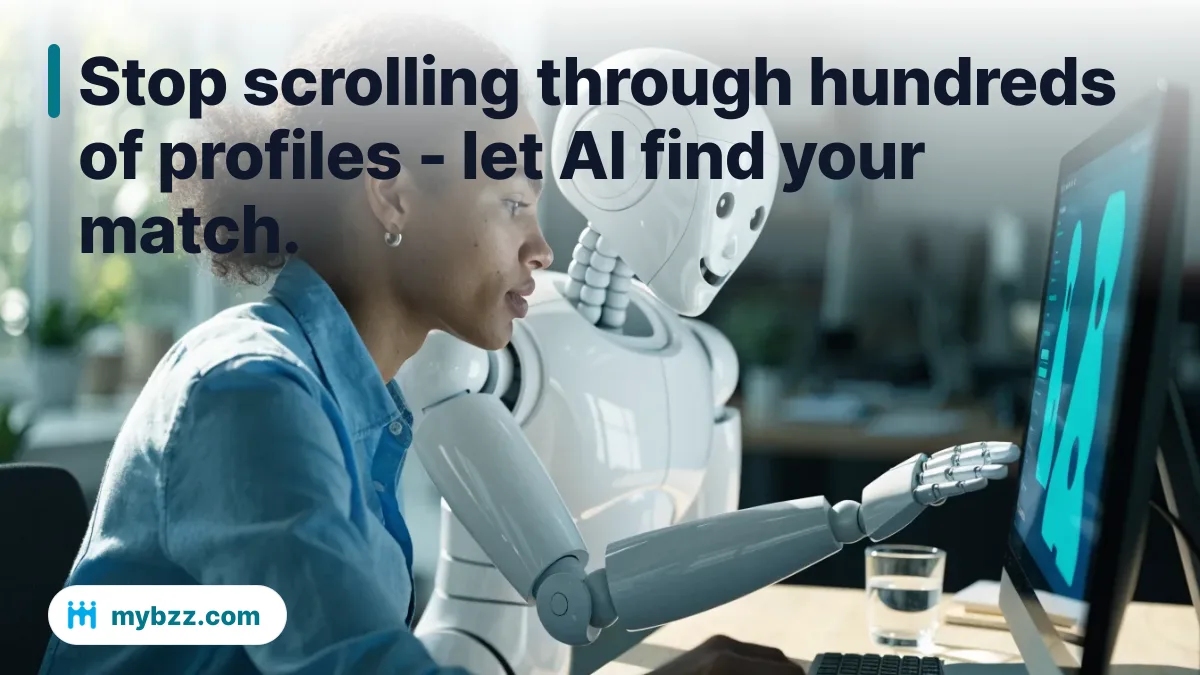
Privacy is the most underdiscussed issue in AI partner matching: these platforms run on deeply personal data – your goals, business plans, sometimes your financials – so how that data is handled should drive your choice of tool.
The ethical concerns worth naming plainly:
- Data security: profiles contain sensitive business intent. A breach exposes your strategy, not just an email.
- Algorithmic bias: if training data skews toward certain industries or demographics, matches inherit that skew.
- Transparency: many platforms won’t tell you why you were matched with someone.
- Consent and memory: some AI tools remember conversations across sessions. Useful, but you should know it’s happening.
"If a matching platform can’t explain how it uses your data, treat that silence as the answer."
For business use, favor platforms that keep conversations private, let you control your profile fully, and don’t repackage your intent data for advertising. Ask one concrete question: can I delete my data and see what the system knows about me? If the answer is unclear, that’s a signal.
What future trends define the AI partner matching platforms outlook 2025 and beyond?
The outlook points toward zero-input matching, where AI agents handle discovery so you barely lift a finger.
-
Agent-driven curation. Instead of browsing, an AI agent interviews you, scouts candidates, and presents a short list. Bumble’s Bee is the mainstream proof.
-
Voice and conversational onboarding. Typing out a profile gives way to a five-minute spoken interview that captures nuance a form never could.
-
Cross-platform intelligence. Matching that factors in events you attend, offers you post, and contacts you made – a continuous graph rather than isolated swipes.
-
Outcome tracking. Platforms will measure whether a match led to a real partnership or funding round, not just whether you messaged.
For the business side, expect matching to tie directly into live opportunities – new offers daily, investor searches, and events in one flow. The same AI-powered relationship tools that reshaped dating are being retooled to track professional outcomes.
How does Mybzz compare to other networking options?
Mybzz compares to general networking tools the way a precision instrument compares to a megaphone: we prioritize relevance over reach. Large networks and casual meetup tools optimize for volume – more connections, more posts, more noise. We optimize for fit.
Event-first tools like meetup platforms work well for local gatherings; our breakdown in Mybzz vs meetup covers when each makes sense. Curated lunch-style networking appeals to people who want scheduled 1:1s; we lay out the trade-offs in Mybzz vs lunchclub.
"The best match isn’t the person you found fastest – it’s the one you’d never have found alone."
For a founder who needs a co-founder in Berlin or an investor in Tokyo, that focus beats a bigger but blurrier network.
FAQ
How much do AI partner matching platforms cost?
On the business side, our platform offers a free plan with no time limits, and posting a business offer costs nothing – you only pay for added visibility.
Are AI matching platforms better than in-person networking?
They serve different needs. AI platforms win on speed and global reach; in-person events build trust faster.
Is my data safe on AI matchmaking platforms?
It depends entirely on the platform. Sensitive business data requires strong security and clear deletion controls. Before committing, confirm you can view and delete what the system stores, and check whether your data is reused for advertising.
What makes business matching different from dating matchmaking?
Dating apps optimize for personality and attraction; business matching optimizes for complementary goals and skills. A technical founder paired with a sales-driven one is a strong business match even if they’d never swipe right socially.
Will AI replace human judgment in choosing partners?
No. AI narrows the field and surfaces strong candidates, but the final call – whether you trust someone and want to build together – stays with you. The technology handles discovery; you handle the decision.
The shift is clear, and the AI partner matching platforms outlook 2025 confirms it: matching is moving from endless scrolling to AI that does the hunting for you, and platforms built around business intent will come out ahead. If you’re a founder tired of cold outreach that goes nowhere, create a free account on Mybzz and post your first offer today. It takes minutes, costs nothing, and puts you in front of the exact partners and investors you’ve been searching for the long way around.
Rate this article
Ready to grow your business?
Download MYBZZ for free and join thousands of entrepreneurs.
Download the app for free

Related articles
Essential Tools for Freelancers Expanding Global Reach
16.11.2026 · 8 min
Guide to International Networking Tools for Entrepreneurs
15.11.2026 · 7 min
Local networking apps vs. in-person meetups: which is better?
13.11.2026 · 6 min