Convert Networking Contacts to Partnerships in 2026
 Katarzyna Górecka
•
•
7 min read
•
★★★★★5/5 (424 reviews)
Katarzyna Górecka
•
•
7 min read
•
★★★★★5/5 (424 reviews) Transform your networking contacts into powerful partnerships with our AI-driven app in 2026. Explore new growth opportunities today!

You met someone great at a conference. You swapped cards, promised to "stay in touch," and now that contact sits dead in your inbox. To convert networking contacts to partnerships, lead with value before you ask for anything, follow up within 48 hours, and propose a small joint test before any formal deal. Partnerships form when two people repeatedly help each other and see results, not when you send a generic "let’s collaborate" message six months later.
The gap between a business card and a signed agreement is mostly follow-through. This guide gives you a concrete 2026 playbook: how to add value, track relationships, run micro-experiments, and use the right tools to turn cold contacts into working partners.
Why most networking contacts never become partnerships
A partnership is a mutual, ongoing business relationship where two parties combine resources for shared results. Networking is just the introduction. Confusing the two is why so many contacts go nowhere.
Most people treat networking as a transaction: collect cards, pitch fast, move on. Building real connections takes time and requires focusing on the other person’s needs first. As the team at BNI puts it in The Art of Transforming Connections into Business Value, lasting business value grows out of genuine relationships, not quick exchanges.
The other silent killer is speed. Following up within 24 to 48 hours dramatically improves your conversion rate, because you’re still fresh in the other person’s memory. Wait a week and you’re a stranger again. The people who close partnerships aren’t the loudest in the room, they’re the fastest and most consistent afterward.
Add value first: the reciprocity rule
Add value first means offering something useful, an introduction, a piece of industry news, or a solution, before you ask for anything in return. This creates reciprocity, the natural human tendency to give back to those who’ve helped us.
Reciprocity isn’t a trick. When you help someone without expecting an immediate return, you signal that the relationship matters more than the transaction. Adding value separates memorable contacts from forgotten ones, and it costs almost nothing beyond attention.
Practical ways to add value early:
- Make a warm introduction to someone in your network they’d genuinely benefit from meeting
- Share a relevant article, tool, or job lead tied to a problem they mentioned
- Give honest feedback on their product, pitch, or website
- Promote their content or event to your own audience
You bring what they lack, they bring what you lack. That asymmetry is the whole point of a partnership.
Meet entrepreneurs who think like you
MYBZZ — the networking app for business. Free on iOS & Android.
The master connector’s toolkit: questions, listening, follow-up
A master connector is someone people trust to make the right introduction at the right time. That reputation is built on two skills: asking open-ended questions and practicing active listening.
Open-ended questions ("What’s the hardest part of scaling your team right now?") pull out real problems you might solve. Active listening means you actually remember the answer and act on it later. Most people wait for their turn to talk. Master connectors take notes.
A follow-up sequence that consistently moves contacts toward partnerships:
- Within 48 hours: send a personal message referencing something specific you discussed, plus one piece of value (a link, intro, or resource).
- Week two: check in with no ask. Share progress or send relevant news.
- Week four: propose a low-stakes way to work together, a call, a shared post, a small pilot.
- Ongoing: keep documenting interactions so you spot collaboration openings early.
Documenting matters. Half of professionals lose track of their network, and a forgotten contact is a lost partnership. Whether you use a spreadsheet, a CRM, or a tool like Careerflow.ai, recording who you met and what they need is what separates a networker from a connector.
Run micro-experiments before committing
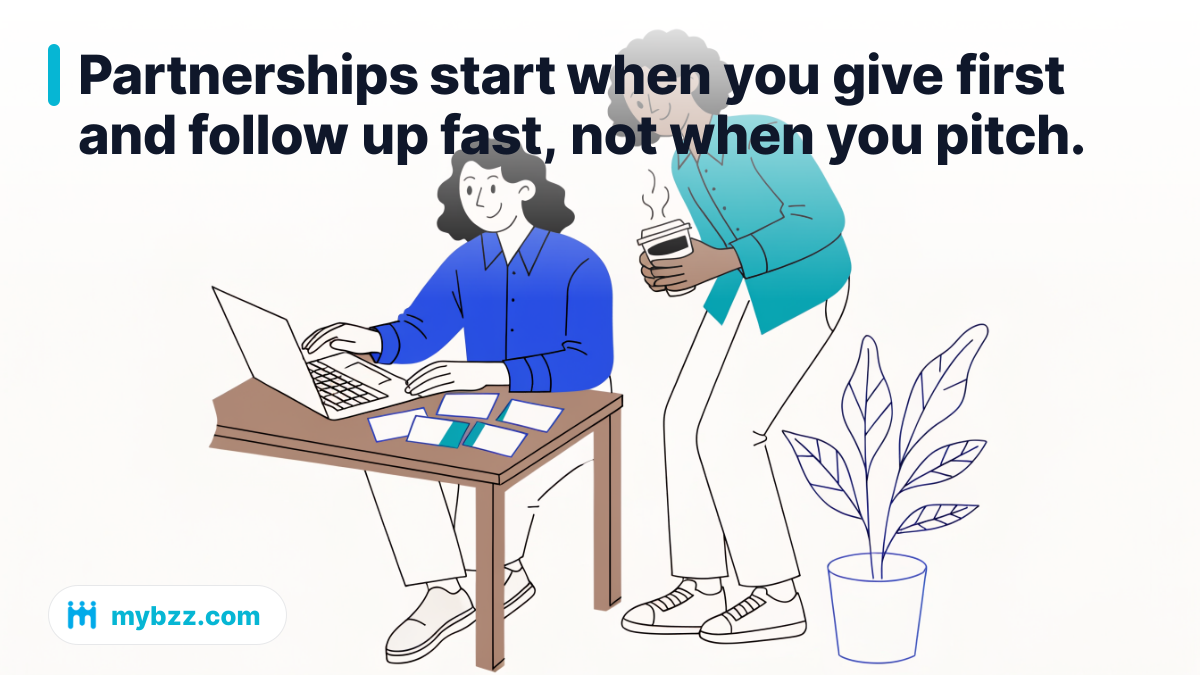
The fastest way to convert networking contacts to partnerships is to test compatibility with a small project first. Nobody should sign a joint venture with someone they’ve never actually worked with.
A micro-experiment is a tiny, low-risk collaboration that reveals whether two people work well together: co-writing an article, cross-promoting a webinar, or running a two-week pilot. If it goes well, you scale up. If not, you part ways with your reputation and bank account intact.
| Micro-experiment | Time investment | What it reveals |
|---|---|---|
| Co-author an article | 3-5 hours | Communication style, reliability |
| Cross-promote a webinar | 1 day | Audience overlap, marketing fit |
| Two-week referral pilot | 2 weeks | Lead quality, follow-through |
| Joint mini-workshop | 1 week | Delivery, client feedback |
A micro-experiment surfaces those signals fast, without a contract locking you in.
Tools that help you convert networking contacts to partnerships
Modern networking runs on both online and offline engagement. Here are options worth using in 2026.
Mybzz – our AI-powered business networking platform matches entrepreneurs with partners, investors, and opportunities worldwide. Instead of scrolling endless feeds, our matching surfaces relevant people fast, which is why the Mybzz application for business counts among the app wins for entrepreneurs who value time.
- AI matching for partners and investors — AI-driven matching algorithms streamline the process of identifying potential partners and investors, enhancing the likelihood of successful collaborations
- Global reach, business-first design — A business-first design prioritizes meaningful interactions and value creation, enhancing the potential for global partnerships and collaborative success
- Dedicated to real deals, not casual social contacts — Building meaningful partnerships requires consistent effort and genuine interest, rather than treating networking as a mere transaction for quick gains
- Who it’s for: founders and business owners networking internationally
Digital business card apps (NFC technology) – a digital business card shares your contact details, links, and branding with a tap. NFC captures leads instantly and syncs them to your contacts, no lost paper cards. Ideal for events.
CRM and tracking tools – Careerflow.ai and lightweight CRMs let you log interactions, set follow-up reminders, and track each relationship.
For a full breakdown, we compared the 8 Best Business Networking Apps in 2026 and reviewed Shapr alternatives. If you’re building deliberately with Mybzz.com, pairing AI matching with solid lead capture and tracking is the combination that moves contacts into contracts. You can also explore more business networking online strategies.
FAQ
What is the difference between networking and partnership?
Networking is the process of meeting people and building professional relationships. A partnership is a formal, ongoing arrangement where two parties combine resources toward shared goals. Networking creates the contact; the partnership is the outcome when that contact turns into structured, mutual work over time.
What are the 4 C’s of networking?
The 4 C’s are Connect, Communicate, Contribute, and Convert. You connect with new people, communicate consistently, contribute value without expecting immediate returns, and convert the strongest relationships into partnerships. The middle two steps are where most people quit too early.
How do I keep track of networking contacts?
Document every meaningful interaction, who you met, what they need, and your next step. Use a CRM, a spreadsheet, or a tool like Careerflow.ai, and always log a follow-up date.
How fast should I follow up after meeting someone?
Within 24 to 48 hours. Speed significantly increases your conversion rate because you’re still fresh in the other person’s mind. Send a personal note referencing your conversation plus one piece of value, an introduction, a resource, or a relevant idea.
Pick one contact you meant to follow up with and haven’t. Send them something useful today, no ask attached. That single message is how partnerships start, and it’s the step most people skip. Do it now, then build the habit: give first, follow up fast, test small, and track everything. If you want the AI matching that surfaces the right people to begin with, try our app and start turning cold contacts into real collaborators this week.
Rate this article
5/5 (424 reviews)
Ready to grow your business?
Download MYBZZ for free and join thousands of entrepreneurs.
Download the app for free

Related articles
What is the best way to find business partners? A framework that outperforms traditional messaging
10.09.2026 · 8 min
What should you ask a potential business partner: 7 key questions
06.09.2026 · 8 min
Finding the best business collaboration opportunities
16.08.2026 · 12 min