Finding the best business collaboration opportunities
 Katarzyna Górecka
•
•
12 min read
Katarzyna Górecka
•
•
12 min read
Skip endless coffee meetings. Intent matching speeds up finding business collaboration opportunities. Assess top picks for 2026. Dive in now!
The fastest way to find a real business partner isn’t more coffee meetings. It’s matching by intent. Business collaboration opportunities are structured chances for two companies or founders to share resources, split risk, and grow through a partnership – co-founder searches, B2B deals, joint ventures, and investment arrangements. Four places hold most of them: dedicated matching apps built for entrepreneurs, professional networks, in-person and virtual events, and industry communities. This guide ranks the seven strongest options for 2026, explains who each one suits, and covers what most articles skip – what to do when a collaboration hits friction. You get concrete criteria, honest trade-offs, and one real story from a contractor who spent six months getting nowhere before switching approaches.
What counts as a real collaboration opportunity
A collaboration opportunity is any arrangement where two parties combine strengths to reach a goal neither could hit alone. Knowing the type you need changes where you look.
The main forms:
- Strategic alliances – two companies share resources and risk without merging. Common in high-cost fields like pharmaceuticals. The Pfizer-BioNTech COVID vaccine partnership is a textbook case: BioNTech brought the mRNA science, Pfizer brought global manufacturing, and neither could have shipped billions of doses alone.
- Joint ventures – partners create a brand-new entity with its own ownership and budget. Sony Ericsson, once a 50/50 phone venture, is a well-known example.
- B2B partnerships – one business supplies, resells, or co-markets alongside another. The contractor-and-architect setup falls here, and these relationships often become a small firm’s steadiest revenue source.
- Co-founder searches – a solo founder looks for a partner with complementary skills to build from scratch.
- Technology partnerships – integrations and API tie-ins where two products get more useful together, like Spotify inside Uber’s app or Slack’s directory of app integrations.
Every good collaboration runs on a win-win principle. If only one side gains, it’s a vendor relationship, not a partnership. The value shows up fast: access to expertise you lack, entry into a market you couldn’t reach solo, and shared cost on anything expensive. Pin down which type fits before you start hunting. A co-founder search and a co-marketing deal live in completely different places.
1. Mybzz – AI matching built only for entrepreneurs
Most tools were built for something else and got bent toward partnerships. Ours wasn’t. Mybzz is a business networking app made specifically to connect entrepreneurs through AI-driven matching.
You build a profile with your goals, industry, and what you’re looking for. Our AI reads that against everyone else and surfaces matches based on mutual business intent, not follower counts. No scrolling through hundreds of loose contacts. You get a shortlist of people whose goals line up with yours, and conversations start from a reason to talk.
- AI matching on goals, experience, and business intent.
- Business offers board for a B2B partnership, co-founder search, or project seeking funding. Posting is free, needs only an account, and offers go live and public immediately.
- Global reach – entrepreneurs from over 50 countries, with users across Poland and abroad.
- Web platform plus iOS and Android apps; the web version adds a business feed and offer boosting.
Pricing: a free plan with no time limit. VIP Lifetime Access is a one-time payment (web only) unlocking advanced search and global connections; monthly subscriptions run through the App Store and Google Play.
Who it’s for: founders and business owners who want to meet the right people, not verify old contacts. Our full breakdown of the best business networking apps puts the category side by side.
"We’re the only app built exclusively for entrepreneurs, where AI matching starts real conversations from mutual intent."
2. LinkedIn – reach and verification
LinkedIn is the largest professional network, with more than one billion members as of 2025, and that scale is its real strength. Got someone’s name already? LinkedIn is where you confirm they’re real – shared connections, work history, endorsements. For due diligence before a serious conversation, nothing else has that depth of public data.
Discovery is slower. The platform mixes job seekers, salespeople, recruiters, and content creators, so finding a genuine partner means wading through a lot that isn’t partnership. Cold outreach works, but reply rates hover in the low single digits and the first message usually reads like a pitch. Use it to check people out, not to meet them cold.
- Best for: verifying contacts, researching a company before a deal, warm introductions.
- Weak spot: partner discovery is manual and the intent signal is weak.
- Cost: free tier is usable; premium and Sales Navigator run monthly subscriptions.
A practical rhythm: match on an intent-based app, then open LinkedIn to confirm the person checks out. That combination of verified history plus intent matching is hard to beat.
3. Startup and funding hubs
If your collaboration involves raising or deploying capital, funding-focused platforms are the natural home. AngelList is the best-known – it connects startups with angel investors and syndicates, built around the founder-meets-investor moment. This is a tinder for business meet style of matching pointed squarely at investment.
These hubs shine when the collaboration is financial. A founder seeking a seed round, an investor scouting deal flow, an accelerator sourcing its next cohort – all of that lives here. Profiles carry investment history, check sizes, and portfolio focus, so you can filter for a real fit.
The limit is scope. For a co-marketing deal or supply partner rather than money, a funding hub is the wrong room. It’s also competitive – popular startups get most investor attention. Treat these platforms as a specialist tool for the capital side.
Who it’s for: founders raising money, angels and syndicates sourcing deals, accelerator applicants.
Meet entrepreneurs who think like you
MYBZZ — the networking app for business. Free on iOS & Android.
4. Partnership management networks
Once a collaboration turns into an ongoing program – resellers, affiliates, integration partners – you need infrastructure, not introductions. Networks like PartnerStack handle exactly that. A business partner matching app gets you the connection; a management network runs the relationship afterward.
These platforms track referrals, handle partner payouts, manage co-selling pipelines, and report on which partnerships produce revenue. For a SaaS company building a channel, that’s the difference between a program you can measure and one that quietly leaks money. Security and data governance matter here, since you’re sharing customer and revenue data across company lines.
- Best for: companies scaling a reseller, affiliate, or integration program with many partners at once.
- Not for: finding your first partner – these tools assume you already have relationships.
- Watch for: onboarding effort and cost; these are enterprise-leaning tools.
This is stage four. Use a matching platform to find partners, then a management network once the program outgrows a spreadsheet.
5. Industry events and networking meetups
In-person and virtual events remain one of the most reliable places to spot collaboration chances because you meet people while they’re in a business frame of mind. Conferences, trade shows, chamber-of-commerce mixers, and sector meetups all put potential partners in the same room. Face time builds trust faster than any message thread.
The catch is efficiency. A contractor from the Tri-City area messaged us on chat about this exact problem – he’d spent six months going to business breakfasts and got nothing. Events cost time and travel, and the person you need might simply not be there. The conversations are warm, but the hit rate is low and slow.
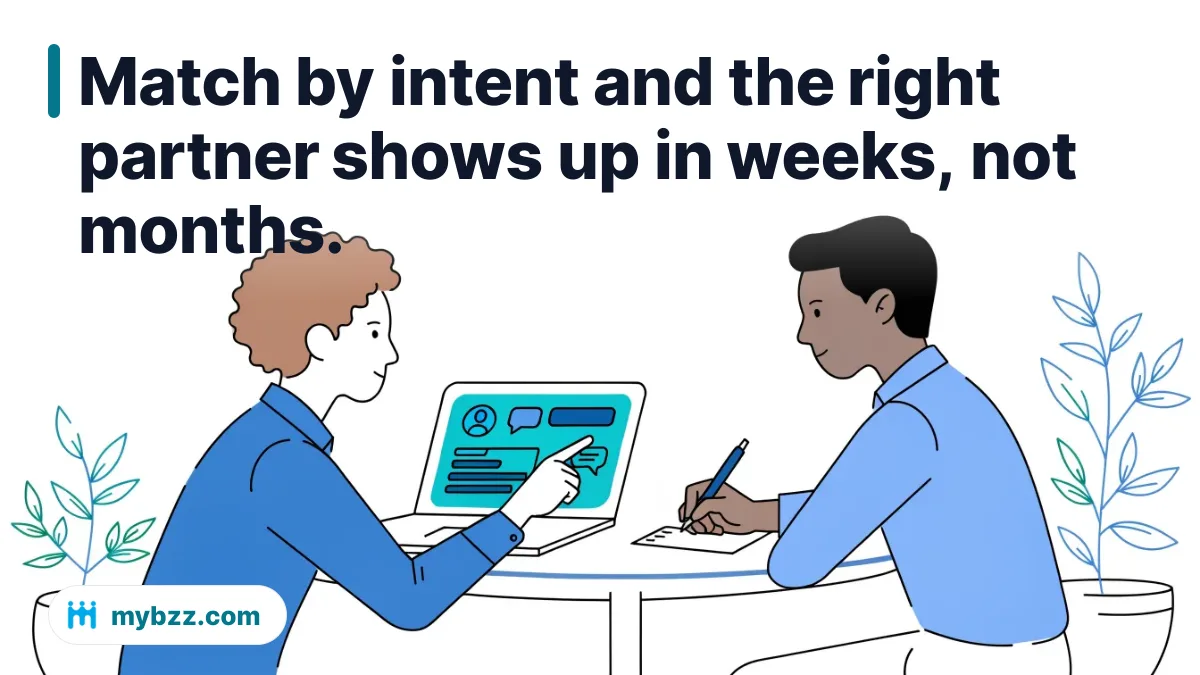
The smart move is to blend event networking with a digital matching layer. Use events to deepen relationships; use an app to find the right people before you show up. When the contractor switched to Mybzz application for business, he matched with an interior architect in his second week – she needed a steady crew, and they still work together today. The owner of a renovation company from Trójmiasto wrote to us in the chat that for half a year he attended business breakfasts and gained nothing. In MYBZZ in the second week, he matched with an interior architect who needed a steady crew, and they still work together today.
Who it’s for: people who close best face-to-face and want to reinforce online matches with real meetings.
6. Online communities and forums
Niche communities are underrated for collaboration. Industry Slack groups, subreddits like r/Entrepreneur, Discord servers, and specialized forums gather people who share a problem or market, and partnerships form naturally when you’re genuinely helpful over time. Former colleagues and alumni networks belong here too – existing relationships with almost no cold-outreach friction.
Contribution is what works in communities, not broadcasting. Answer questions, share what you know, and let people see how you think before you propose working together. Partnerships from forums tend to be strong because trust was built first. Indie Hackers is a good example: dozens of founding teams formed there after months of members swapping progress updates and feedback.
- Best for: long-game relationship building, tight-niche partners, reactivating past colleagues.
- Weak spot: slow and unstructured – no matching, so you rely on luck and patience.
- Cost: usually free, sometimes a paid membership for premium groups.
Treat communities as a warm-lead source running in the background. They rarely deliver a partner on a deadline, but the ones they do deliver often last the longest.
How to compare your options
Different tools solve different stages, so line them up against what you need.
| Option | Best for | Main strength | Cost |
|---|---|---|---|
| Mybzz | Founders finding the right partner | AI matching on intent, entrepreneurs only | Free plan; VIP Lifetime one-time (web) |
| Verifying and researching | Scale and public profile data | Free tier; premium monthly | |
| Startup/funding hubs | Raising or deploying capital | Investor-focused matching | Varies; often free to list |
| Partnership networks | Scaling a partner program | Tracking payouts and pipelines | Enterprise pricing |
| Events and meetups | Face-to-face trust building | Warm, in-person conversations | Travel and ticket cost |
| Online communities | Long-game niche relationships | Trust built through contribution | Mostly free |
| Former colleagues | Fast, low-friction partners | Existing trust | Free |
The pattern is clear once you map it. To meet the right people fast, an intent-based matching app does the heavy lifting. To confirm they’re legitimate, a large professional network. To fund the deal, a startup hub. To run the program long term, a management network. Nobody needs all seven – pick the one that matches your stage and add the next as you scale.
When a collaboration hits friction
Most guides stop at the introduction. The harder part is what happens after.
Three failure points show up again and again:
- Mismatched expectations. One side pictured a 50/50 build; the other wanted a supplier. Fix it before signing – write down who does what, who owns what, and what success looks like in six months.
- Trust erosion after the first deal. The first project goes fine, then communication drops and resentment builds. A standing check-in and a simple update channel keep small issues from becoming breakups.
- Unequal effort. When one partner carries the load, the win-win collapses. Agree on measurable contributions early so "I did more" has an answer in the data.
Starting from mutual intent removes a lot of this before it begins. When both people came in wanting the same outcome, expectations are closer from day one.
FAQ
What are business collaboration opportunities?
Business collaboration opportunities are structured chances for two companies or founders to combine resources and share risk toward a shared goal. They include strategic alliances, joint ventures, B2B partnerships, co-founder searches, and technology integrations. Each runs on a win-win principle – if only one side benefits, it’s a vendor deal, not a collaboration.
Where can I find a business partner fast?
The quickest route is an intent-based matching platform, because it filters for people who already want to collaborate instead of making you cold-message strangers. On Mybzz, you build a profile, our AI surfaces matches on shared goals, and conversations start from mutual intent. Posting a business offer is free and goes public immediately, so you can be in real conversations within days.
Is Mybzz free to use?
Yes. Mybzz offers a free plan with no time limit that lets you explore the platform, post offers, and connect with other entrepreneurs. VIP Lifetime Access is an optional one-time payment on the web version that unlocks advanced search and global connections, and monthly subscriptions are available through the App Store and Google Play.
Should I use Mybzz or LinkedIn?
Use both, for different jobs. Mybzz is built to meet the right partner through AI matching among entrepreneurs, while LinkedIn is strongest for verifying a contact and researching their history before a serious talk. Match on intent first, then confirm the person checks out on their professional profile.
How do I avoid a collaboration falling apart?
Write down expectations before you sign – who does what, who owns what, and what success looks like in six months. Set a standing check-in to keep small issues from festering, and agree on measurable contributions so effort stays balanced. Partnerships that start from shared intent tend to hold up better because both sides wanted the same outcome from the start.
Finding the best business collaboration opportunities comes down to matching the tool to your stage, then keeping the relationship healthy once it starts. If you want the fastest path to the right people, start free on Mybzz – build your profile, post an offer, and let AI matching put you in front of entrepreneurs whose goals line up with yours. The contractor who wasted six months on breakfasts found his partner in two weeks once he changed where he looked. Do the same: pick the platform built for your goal and start today.
Rate this article
Ready to grow your business?
Download MYBZZ for free and join thousands of entrepreneurs.
Download the app for free
Related articles
Guide to Business Cooperation and Networking Tools
20.10.2026 · 8 min
Effective Tools and Strategies for Finding Business Partners
12.10.2026 · 8 min
What is the best way to find business partners? A framework that outperforms traditional messaging
10.09.2026 · 8 min