Top 5 platforms for effective social media advertising
 Katarzyna Górecka
•
•
9 min read
Katarzyna Górecka
•
•
9 min read
Explore the top social media advertising platforms to boost your business reach. Enhance your strategy with our expert insights. Dive into our guide now!
Choosing where to spend your ad budget shouldn’t feel like flipping a coin. Social media advertising platforms are the paid tools that let you promote a business through targeted campaigns across networks like Facebook, LinkedIn, TikTok, and YouTube. Here’s the short version. If you sell products to consumers, start with Meta Ads. Sell to other businesses? LinkedIn earns its higher price tag. Want cheap reach and younger buyers? TikTok wins. This guide breaks down the top 5 platforms for effective social media advertising in 2026 – who each one fits, what it costs to run, and where it tends to let you down. We’ll also cover how to choose, so you stop pouring money into the wrong channel.
What social media advertising platforms actually do
A social media advertising platform is a paid campaign manager. It places your ads in front of a chosen audience inside a social network, then reports back on what those ads earned. The goal is to reach the right people, at the right cost, with proof of results.
This matters more than it used to. Social advertising is the second biggest slice of the digital ad market, valued at around $153 billion in 2021, and total digital ad spend hit an estimated $1.14 trillion in 2025. That’s a crowded auction. The platforms that win have granular targeting, honest reporting, and formats people don’t instantly scroll past.
Two quick terms worth knowing. Return on ad spend (ROAS) is how much revenue each dollar of ad spend brings back – a ROAS of 4 means $4 back for every $1 in. Brand awareness measures how many new people discover you. Most campaigns chase one or the other, rarely both at once. Keep that distinction in mind and you’ll pick smarter.
1. Meta Ads Manager (Facebook and Instagram)
Meta Ads Manager runs paid campaigns across Facebook and Instagram from one dashboard, and it’s still the default choice for most small and mid-sized businesses. The reach is enormous. The targeting is deep. And the cost of entry is low enough to test with a few dollars a day.
It shines with B2C brands and e-commerce. If you sell physical products, local services, or anything with a clear buyer, Meta’s interest and behavior targeting does a lot of the heavy lifting. You also get formats built for attention: Reels, Stories, and Carousel ads, each suited to a different goal.
Key features:
- Granular targeting by interest, behavior, location, and lookalike audiences
- Direct product catalog sync for shopping ads
- Built-in A/B testing and conversion tracking via the Meta pixel
Best for: B2C brands, local businesses, and online stores.
Cost: No minimum. Most beginners start at $5-$20 per day and scale what works.
The catch is competition. Popular audiences get expensive, and iOS privacy changes have made conversion tracking messier than it once was. Plan for a learning period before your ROAS settles into something you can scale.
2. LinkedIn Ads
LinkedIn Ads is the strongest platform for B2B marketing, lead generation, and professional services. Nowhere else can you target by job title, company size, industry, and seniority with this precision. If you sell to decision-makers, that filtering is worth a lot.
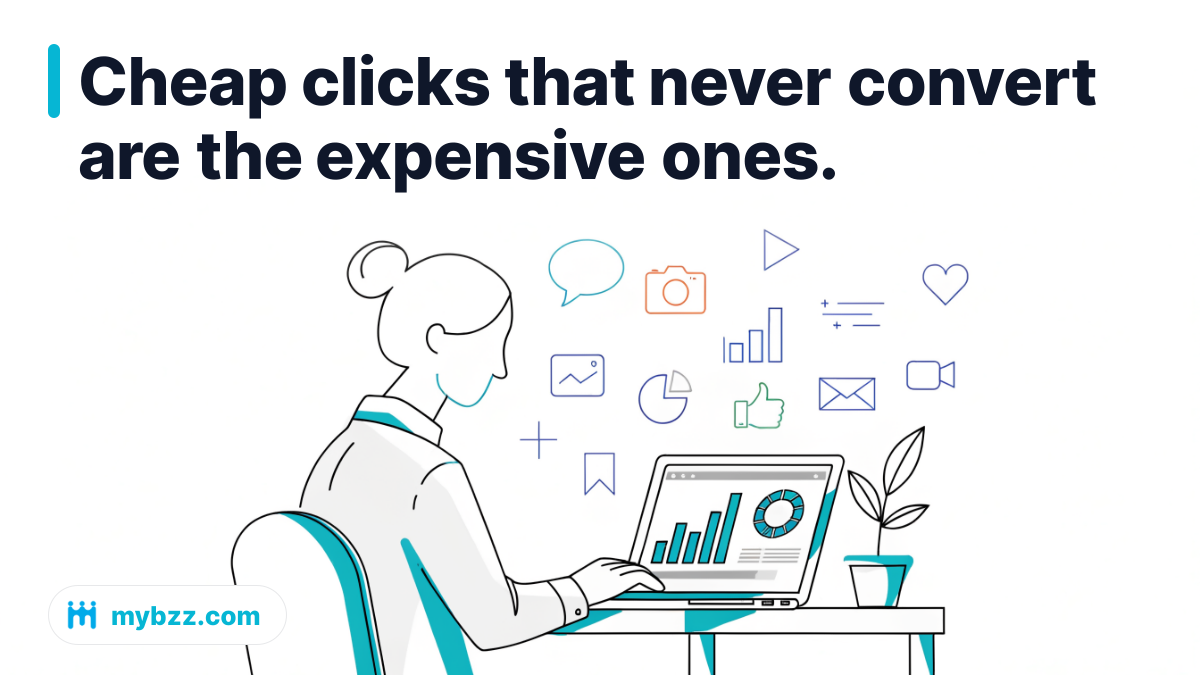
The trade-off is price. Clicks and leads on LinkedIn cost noticeably more than on Meta, sometimes several times more. But a single closed deal in B2B often covers a month of ad spend, so the math works when your average order value is high. Cheap clicks that never convert are the expensive ones.
The organic side – connecting with the right partners and investors – is where tools like Mybzz.com come in, using AI matching to pair you with relevant contacts worldwide. Ads bring volume. Smart networking brings the introductions that close.
Key features:
- Targeting by job function, seniority, and specific companies
- Lead Gen Forms that pre-fill contact details
- Sponsored content, message ads, and document ads
Best for: B2B services, SaaS, recruiters, and high-ticket offers.
Cost: Higher cost per click; typical minimums start around $10 per day.
Meet entrepreneurs who think like you
MYBZZ — the networking app for business. Free on iOS & Android.
3. TikTok For Business
TikTok For Business is built for brand awareness and reaching younger audiences, especially Gen Z and younger millennials. Brands can reach almost 2 billion people on the platform, and the algorithm rewards content that feels native rather than polished and salesy.
What works on TikTok is short-form video, creator partnerships, and user-generated content. A clever 15-second clip from a small brand can outperform a big-budget production, because the feed doesn’t care who made it – only whether people watch. That levels the field in a way few social media advertising platforms manage.
Key features:
- Spark Ads that boost organic-style creator videos
- Low cost per impression versus Meta and LinkedIn
- Strong for product discovery and impulse purchases
Best for: Visual, product-based brands targeting under-35 buyers.
Cost: Competitive CPMs; many advertisers see cheaper reach than on Meta.
The honest downside: TikTok demands constant fresh creative. What performed last month tires fast, and you’ll burn through ideas quicker than on any other channel. Budget your time, not just your money.
4. YouTube Advertising
YouTube Advertising taps the world’s second-largest search engine, which makes it the go-to for educational content, product demos, and long-term brand building through video. People arrive on YouTube in a searching, learning mindset, so ads that teach something tend to stick.
Formats range from skippable in-stream ads to short bumper ads and discovery placements that show up in search results. Because it runs through Google Ads, you also inherit Google’s intent data, layering keyword and audience targeting on top of demographics. That combination is rare among digital advertising platforms.
Key features:
- Skippable, non-skippable, bumper, and in-feed video formats
- Targeting by search intent, topic, and viewing behavior
- Deep integration with Google Ads and analytics
Best for: Brands with demo-worthy products, courses, or explainer content.
Cost: You often pay only when viewers watch 30 seconds or engage.
The bottleneck is production. Weak video underperforms fast, and viewers hit skip within five seconds if the opening doesn’t grab them. Front-load your hook or lose the click.
5. Cross-channel platforms like AdRoll
Once you’re running ads on more than two networks, managing each dashboard separately gets painful. Cross-channel platforms like AdRoll pull multiple social media advertising platforms into one interface, so you can plan, launch, and measure everything from a single view. That’s the pitch, and for scaling businesses it holds up.
AdRoll integrates with TikTok, Facebook, Instagram, Pinterest, and the open web, letting you retarget the same audience across places they already visit. The platform provides hourly imports of historical campaign data, which makes performance analysis far less of a guessing game. You manage and adjust campaigns across channels without hopping between five tabs.
That said, multi-platform tools aren’t for everyone. If you advertise on a single channel, native managers like Meta Ads Manager or LinkedIn Campaign Manager are tailored to their own networks and give you deeper platform-specific controls. The extra features of cross-channel tools may not be worth it until you’ve outgrown one or two networks.
Key features:
- Unified dashboard across social and display networks
- Cross-channel retargeting and audience syncing
- Hourly historical data imports for reporting
Best for: Growing brands running ads on three or more channels.
How to choose the right platform for your business
There’s no single best platform, only the best fit for your audience, budget, and goal. Start by asking who you’re trying to reach, then let that answer point you to a channel. Chasing every network at once is how small budgets get spread too thin to work.
A few practical rules worth following:
- Match the platform to your buyer. B2C and e-commerce lean Meta and TikTok; B2B leans LinkedIn.
- Match the format to your product. Visual products love TikTok and Instagram; demos and courses love YouTube.
- Start narrow. Master one channel and prove positive ROAS before adding a second.
- Budget for testing.
- Add cross-channel tools later. Bring in AdRoll or similar once you genuinely run three-plus networks.
A strong paid social approach usually starts with one channel done well. If you want a fuller comparison of channels beyond paid ads, our guide to the best platforms for small business walks through organic reach too, and our overview of social media for businesses covers where each network fits.
| Platform | Best for | Standout strength | Relative cost |
|---|---|---|---|
| Meta Ads | B2C, e-commerce, local | Granular targeting | Low entry |
| LinkedIn Ads | B2B, high-ticket | Job-title targeting | High |
| TikTok | Younger audiences, brand awareness | Cheap viral reach | Low-medium |
| YouTube | Demos, education, brand building | Intent + video | Pay-per-view |
| AdRoll | Multi-channel scaling | One unified dashboard | Medium |
FAQ
What is the best social media platform for ads?
It depends on your audience. Meta Ads is the best all-round starting point for most B2C and e-commerce businesses because of low cost and precise targeting. For B2B, LinkedIn Ads delivers higher-quality leads despite higher prices, while TikTok wins for reaching younger buyers cheaply.
What are the major social media platforms used for advertising?
The main paid channels are Meta (Facebook and Instagram), LinkedIn, TikTok, YouTube, Pinterest, X (Twitter), and Snapchat. Most businesses see the strongest results concentrating on two or three that match their audience, rather than spreading a budget across all of them.
What is the 5-5-5 rule for social media?
The 5-5-5 rule is a simple posting balance: engage with 5 people, share 5 pieces of others’ content, and post 5 of your own, within a set period. It’s an organic engagement habit, not a paid advertising strategy, but it keeps accounts active enough to support your ad campaigns.
How much should I budget for social media ads?
Most small businesses can test effectively at $5-$20 per day per platform. The goal early on isn’t profit, it’s data: learn which audience and creative combination earns positive ROAS, then scale that. Higher-cost channels like LinkedIn need larger budgets to gather meaningful results.
Pick the one platform where your buyers actually spend time, commit to it for at least a month, and read the numbers honestly before expanding. Meta for consumers, LinkedIn for B2B, TikTok for young audiences, YouTube for demos, a cross-channel tool once you’ve earned it. That’s the whole map. Then pair those paid campaigns with real relationships, because the warm introduction still closes deals no ad ever could. Start narrow this week, prove one channel works, and let the results decide your next move.
Rate this article
Ready to grow your business?
Download MYBZZ for free and join thousands of entrepreneurs.
Download the app for free
Related articles
Best Social Media platforms for business
21.04.2026 · 6 min
How to Choose the Best Social Media Platform for Business Growth?
06.03.2026 · 5 min
The Best Social Media Platform for Business – How to Choose and Use It for Company Growth?
11.02.2026 · 7 min