Understanding Networking Frameworks for Entrepreneur Success
 Katarzyna Górecka
•
•
8 min read
Discover proven networking frameworks for entrepreneur success with our AI-driven app, enhancing your global business connections. Start building today!
Every entrepreneur eventually hits the same wall: plenty of contacts, no results. A networking framework is what fixes that. These frameworks are structured methods for building relationships, keeping them warm, and turning them into real outcomes – partnerships, funding, customers, co-founders. Instead of collecting business cards and hoping, you follow a repeatable process that turns strangers into allies.
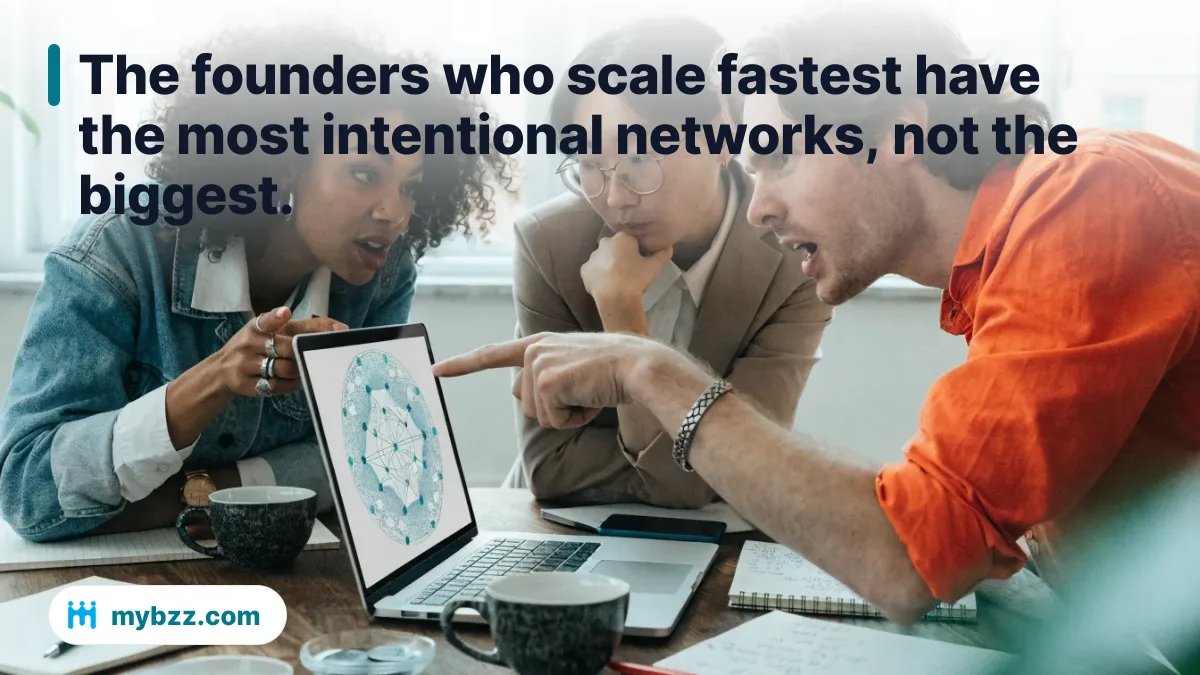
The founders who scale fastest rarely have the biggest networks. They have the most intentional ones. Below you’ll find proven frameworks, the tools that make each one work, and how to pick the right combination for wherever your business is right now.
The VCP process: visibility, credibility, profitability
VCP is a three-stage framework that explains how a relationship matures into revenue. Visibility means people know you exist. Credibility means they trust that you deliver. Profitability means those relationships generate business – referrals, deals, introductions.
Most entrepreneurs get stuck at visibility. They post, attend, connect, then wonder why nothing happens. Nobody jumps straight from meeting you to sending money. Credibility gets earned in between, through consistent follow-through and small proofs that you know your stuff.
Use VCP as a diagnostic. Ask where each important contact sits:
- Visibility gap: they don’t know what you do. Fix it with a clear, one-line value proposition.
- Credibility gap: they know you but haven’t seen results. Fix it by delivering something small and useful before asking.
- Profitability gap: they trust you but you’ve never asked. Fix it with a specific, low-friction request.
The framework works best paired with a platform that shows business intent upfront, so you skip cold visibility entirely. On Mybzz, your goals sit right on your profile – so credibility conversations start faster than from a blank cold message.
The strong-ties and weak-ties framework
Sociologist Mark Granovetter’s classic idea still holds up for founders. Your closest contacts – strong ties – rarely bring new opportunities, because they know the same people you do. New deals, jobs, and introductions usually come from acquaintances (weak ties) in different circles.
Your network needs deliberate balance. Strong ties give emotional support and honest feedback – the peer who tells you your idea has a flaw before an investor does. Weak ties give reach into markets, industries, and countries you can’t access alone.
Here’s how to work it:
- Map your network into strong ties and weak ties.
- Notice which category is thin – most founders are heavy on strong ties, starved for weak ones.
- Deliberately add weak ties in adjacent industries and other countries.
- Convert the highest-potential weak ties into stronger relationships over time.
This is where cross-border collaboration becomes a real advantage. A founder in one country reaching an operator in another is exactly the weak-tie leap Granovetter described. Our AI matching supports connections across more than 50 countries, so building weak ties abroad no longer depends on who happens to show up at your local meetup.
Meet entrepreneurs who think like you
MYBZZ — the networking app for business. Free on iOS & Android.
The give-first (reciprocity) framework
The give-first framework flips the script: you offer value before you ask for anything. Reciprocity is one of the most reliable patterns in human behavior – when someone helps you, you feel pulled to return the favor.
This isn’t about grand gestures. It’s small, specific help. An introduction. A relevant article. Honest feedback on a pitch deck. A tag on a post. The founder who consistently gives becomes the person everyone wants in their corner. When you eventually need investor access or a co-founder, the goodwill is already banked.
| Approach | First message | What the other person feels | Typical result |
|---|---|---|---|
| Transactional | "Can you introduce me to X?" | Put on the spot | Slow or no reply |
| Give-first | "Saw your post – here’s a resource that fits" | Genuinely helped | Reply, then reciprocity |
One caution: give-first only works when it’s sincere. People spot manufactured generosity fast. Help because it costs you little and means a lot to them – the payback takes care of itself. For a deeper look at structuring outreach, see our guide to 8 best business networking practices.
The intentional-matching framework for modern networking
Traditional frameworks assume you go hunting for the right people. Intentional matching assumes technology surfaces them for you – and that shift is what defines networking frameworks for entrepreneur success in 2026. Instead of scrolling endless profiles, you define your goals and let AI connect you with people whose goals align.
Intentional matching means every connection starts from mutual business intent rather than a cold guess. On our platform, the AI analyzes profiles, industries, and objectives, so the person on the other side is already relevant when the conversation opens. That removes networking’s biggest cost: time wasted on people who were never a fit.
We saw this play out. The owner of a renovation company from the Tri-City wrote in chat that he’d attended business breakfasts for six months and gained nothing. On Mybzz, in his second week, he matched with an interior architect who needed a permanent team. They’ve worked together ever since. Six months of coffee versus two weeks of the right algorithm.
The features that make this framework work:
- AI matching from mutual intent: connections start because goals overlap, not because you both clicked "connect."
- Global reach: entrepreneurs from Poland and abroad, across 50+ countries.
- Free plan with no time limit: build and connect without a paywall clock running.
- Web and mobile access: the web version adds a business feed for ongoing visibility.
Choosing the right platform for each framework
Every framework needs the right venue. For discovery and meaningful matches, purpose-built apps do the most work. We built Mybzz exclusively for entrepreneurs, which separates it from broad social networks and from apps like Bumble Bizz or Entre that split their attention across too many use cases. Our comparisons of Mybzz vs bumble bizz and Mybzz vs entre break down the differences, and our take as a shapr alternative walks through what quality-over-quantity matching actually delivers.
Other tools still play a role. When someone matches with you, they’ll check your LinkedIn to confirm you’re real. That’s its job in your stack – the credibility check, not the discovery engine.
A simple stack that fits the frameworks above:
- Discovery + intentional matching: Mybzz – AI matching, free plan, VIP Lifetime Access as a one-time web payment for advanced search and global connections.
- Verification + broad reach: LinkedIn – confirm identities, publish long-form.
- In-person credibility: local events and industry conferences – nearly everyone agrees face-to-face builds longer-lasting relationships.
Don’t pick just one. Match each tool to the stage of the relationship – discovery, verification, deepening.
FAQ
What is a networking framework and why do entrepreneurs need one?
A networking framework is a structured, repeatable method for building and converting professional relationships into business results. Entrepreneurs need one because random networking wastes time – a framework tells you who to reach, what to offer, and when to ask. It turns scattered contacts into a reliable source of partnerships, funding, and customers.
Which networking framework works best for finding investors?
The give-first framework combined with intentional matching. Investors back people they trust, so banking goodwill through small, genuine help before you pitch matters more than a polished cold email. Pair that with AI matching and you reach investors whose focus already aligns with your business.
How is AI matching different from searching for contacts manually?
Manual searching means you scroll, guess, and message people hoping they’re relevant. AI matching analyzes profiles, industries, and goals, then surfaces people whose objectives overlap with yours. The connection starts from mutual intent, which cuts the noise and raises the odds a first message turns into a real conversation.
Can these frameworks work for cross-border networking?
Yes. The weak-ties framework is built for reach into new circles, and cross-border collaboration is the ultimate weak-tie move. With AI matching across 50+ countries, you can deliberately add contacts in markets you couldn’t touch at a local event, then deepen the promising ones over time.
Pick one framework and one platform this week, not all four at once. If you’re chasing investors, start give-first. If your network is all strong ties, go hunt weak ties abroad. The fastest way to test any of this is to set up a profile with clear goals and let intentional matching handle the discovery – our free plan has no time limit, so there’s no reason to wait. Six months of business breakfasts or two weeks of the right match: the framework you choose decides which one you get.
Rate this article
Ready to grow your business?
Download MYBZZ for free and join thousands of entrepreneurs.
Download the app for free

Related articles
Essential Tips for Building Business Contacts Effectively
13.10.2026 · 7 min
Successful networking stories from female entrepreneurs
06.10.2026 · 8 min
Tips for Networking with Investors: Achieve Success
04.10.2026 · 9 min