How to Find Business Directory: Reliable Tips
 Katarzyna Górecka
•
•
8 min read
Learn how to find business directory resources efficiently with our expert tips. Discover which directories best suit your needs today!
Finding a business directory starts with a search. Type your location plus terms like "business listings," "company directory," or your industry name into Google. The right directory, though, depends on what you actually need. Are you listing your own company, checking out a vendor, or hunting for a partner? A business directory is an organized list of companies with details like name, contact information, location, and services offered. Some cover everything; others stick to one niche or region. The trick is matching the directory type to your goal. This guide covers where to look, how to tell whether a directory is trustworthy, and when a modern matching tool beats a static list entirely.
What is a business directory and how do you find one?
A business directory is an organized database of companies listing their names, contact details, locations, and the products or services they offer. Think of it as a phone book that grew up. Most now live online, searchable by category, city, or keyword.
To find one, start with these methods:
- Search engines: Type your city or industry plus "business directory," "company listings," or "local businesses." Google and Bing surface both general and niche directories.
- Map platforms: Google Business Profile and Apple Business Connect double as directories – search a service type near your location to browse verified listings.
- Review-based directories: Yelp, Better Business Bureau (BBB), and Yellow Pages combine listings with ratings and verified contact data.
- Industry associations: Trade groups and chambers of commerce run member directories specific to one sector.
Each method answers a different question. A map platform helps you find a nearby plumber. An industry association directory helps you find a certified supplier. Knowing which one to use saves hours of scrolling through listings that don’t fit.
How do you choose the right directory for your business type?
The right directory depends on three things: your industry, your region, and whether you want to be listed or want to find someone. A restaurant and a software consultancy need completely different ones.
Here’s a practical way to narrow it down:
| Your goal | Directory type | Examples |
|---|---|---|
| Local visibility | Map and local directories | Google Business Profile, Yelp, Yellow Pages |
| Build trust | Review and verification sites | Better Business Bureau, Yelp |
| Reach one industry | Niche or trade directories | Chamber of commerce, sector associations |
| Verify a company | Official registries | State registration databases |
| Find a partner | Matching platforms | Mybzz, LinkedIn |
A general directory casts a wide net but gets noisy. A niche directory reaches fewer people, but they’re the right people. If you run a B2B service, a trade association directory often converts better than a mass-market listing, because visitors already share your context.
One more factor: data freshness. Databases sometimes carry incomplete or conflicting information, so cross-check a listing’s phone number and address before you rely on it. The biggest directory isn’t always the one with the cleanest records.
Meet entrepreneurs who think like you
MYBZZ — the networking app for business. Free on iOS & Android.
How to find business directory listings that are actually trustworthy?
Check three signals: verified contact details, recent activity, and independent reviews. A directory that shows when a listing was last updated and lets customers leave feedback beats a static page that could be years old.
Verified listings build credibility. When a directory confirms a business’s phone, address, and hours, you’re less likely to waste time on dead ends. The Better Business Bureau, for instance, vets companies and flags complaints – handy when deciding whether to trust a vendor you’ve never worked with.
Watch for these red flags:
- No last-updated date or sign of recent activity
- Contact details that don’t match the company’s own website
- Zero reviews on a directory that normally shows them
- Listings that read like ads with no verifiable specifics
A directory is only as good as the data behind it – always cross-verify a contact before you act on it.
Online research is now the default first step for buyers. Most people look up a local business online before contacting it, so a clean, verified listing often decides whether you get the call. For your own company, keeping listings accurate across several directories improves local search rankings through citations and builds the trust that turns a search into an inquiry.
When should you skip directories and use a matching platform instead?
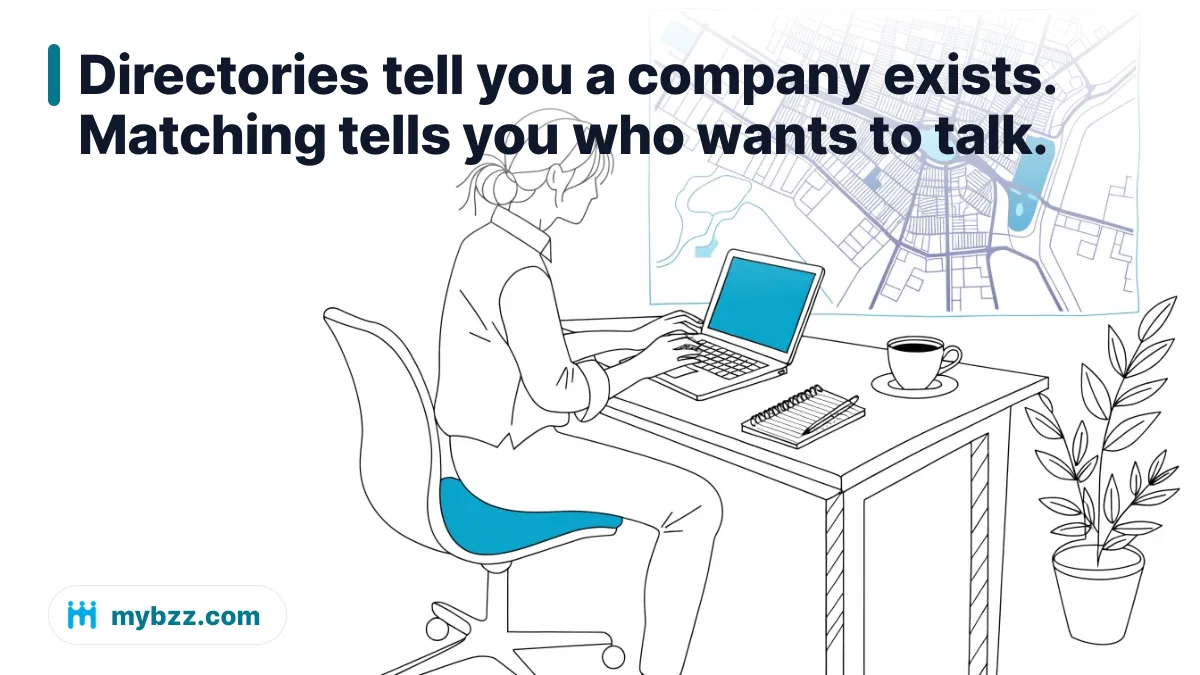
Skip static directories when your goal is to find a business partner, co-founder, or investor rather than a service provider. Directories tell you a company exists. They don’t tell you whether it wants to collaborate, or whether you’re a fit. For that, a matching platform does the work a directory can’t.
That’s the gap we built our platform to fill. It’s sometimes described as a business partner matching app: you set what you’re looking for, and matching starts conversations from mutual interest rather than cold outreach.
A few things set our platform apart from a plain directory:
- AI analyzes profiles, industries, and goals to surface relevant matches
- Entrepreneurs from over 50 countries use it, so reach isn’t limited to one region
- Posting a business offer – a B2B partnership, co-founder search, or funding request – is free with an account
- New offers appear daily and are visible immediately after publishing
If you’ve outgrown searching for a company and now need to meet the right people, our guide to business networking apps explains where each tool fits.
How do business directories and networking tools work together?
Directories and networking tools solve two halves of the same problem, so the smartest approach uses both. A directory is your research layer – it verifies that a company is real, where it operates, and how to reach it. A networking tool is your connection layer – it helps you start the relationship.
Here’s a realistic workflow. Say you’re a founder looking for a manufacturing partner abroad. Step one: use a trade directory or official registry to confirm the companies you’re considering are legitimate and active. Step two: once you know who’s credible, switch to a matching platform to reach the decision-makers directly, or post an offer describing exactly what you want. The directory filters out the noise; the networking tool opens the door.
This combination matters most when you’re expanding into unfamiliar markets. Verification keeps you safe; AI-driven matching keeps you fast. You don’t want to send twenty cold messages hoping one lands. You want to start with people who already signaled interest.
For founders, our piece on how to find business partners who truly complement your strengths goes deeper on choosing the right collaborator, and our overview of real-world networking events covers the in-person side. Treat it as a system – research, then connect. That beats relying on any single list. If you’ve heard someone call a matching app a tinder for business, this is the layer they mean: fast, intent-based introductions instead of endless scrolling.
FAQ
Are business directories free to use?
Most general directories, including Google Business Profile, Yelp, and Yellow Pages, are free to browse and often free to list on. Some niche or premium directories charge for enhanced listings or verified badges. On our platform, browsing, connecting, and posting an offer are free with an account, while a VIP plan unlocks advanced search and global connections.
How do I find a business directory for a specific industry?
Search your industry name plus "directory," "association," or "members" – for example, "software companies directory" or "manufacturers association members." Trade groups and chambers of commerce almost always maintain member lists for their sector. These niche directories reach fewer people, but the audience is far more relevant.
Can a business directory help my company rank higher on Google?
Yes, indirectly. Listing in reputable directories creates citations and backlinks that support local search optimization and can improve rankings. Consistency is key – your name, address, and phone number should match exactly across every directory. Verified, up-to-date listings also build trust with the customers who find you.
What’s the difference between a directory and a matching app?
A directory is a searchable list of companies with their contact details – you do the filtering and outreach. A matching app, like ours, uses AI to introduce you to relevant people based on shared goals, so the connection starts from mutual intent. Directories are best for finding or verifying a specific company; matching apps are best for finding partners, co-founders, or investors.
Start with the goal, not the tool. If you need to verify a vendor or boost local visibility, a few well-chosen directories and a clean, consistent listing will do the job. If you’re hunting for a partner, co-founder, or investor, a static list only takes you halfway – that’s when a matching platform earns its place. Try one of each: list your company on a reputable directory this week, then create a free profile on Mybzz and post what you’re looking for. See which one brings the right people to your inbox – that answer usually comes quicker than you’d expect.
Rate this article
Ready to grow your business?
Download MYBZZ for free and join thousands of entrepreneurs.
Download the app for free

Related articles
How to Find Company Contacts in Outlook: Step-by-Step Guide
21.10.2026 · 7 min
AI-powered tools for lead generation: 5 essential picks
08.10.2026 · 8 min
Top business community apps for entrepreneurs
14.08.2026 · 7 min