Guide to AI Event Matchmaking Platforms and Their Features
 Katarzyna Górecka
•
•
7 min read
AI event matchmaking helps you connect with key partners effortlessly. Discover how our platform optimizes your networking at global events today.
AI event matchmaking fixes that by using algorithms and behavioral data to tell you which of those 500 are actually worth your coffee break.
Instead of hoping to bump into the right investor near the snack bar, you get a ranked shortlist before you arrive. Below, you’ll find the platforms worth knowing in 2026, how each approaches matching, what they cost, and where this technology still falls short.
What AI event matchmaking actually does
It’s software that analyzes attendee profiles and uses machine learning to recommend who you should meet. It replaces the old "walk around and hope" approach with ranked, goal-based suggestions.
The mechanics: you fill out a profile – job title, industry, what you offer, what you’re seeking. The system summarizes that with AI, then compares it against everyone attending. A matching algorithm scores each pairing – a founder raising a seed round scores high against an angel writing checks that size, low against someone selling office furniture. Strong matches surface first, and many platforms let you book meetings in predefined slots at numbered tables.
The useful part is what happens after. Good systems learn from your behavior – who you favorite, message, or ignore – and adjust future recommendations. Reject three enterprise sales reps in a row and the algorithm stops showing them. That feedback loop is the difference between a static directory and something that gets smarter as the event goes on. It works across in-person conferences, virtual summits, and hybrid events.
The platforms worth comparing in 2026
Some tools are built for organizers running 3,000-person expos; others for the entrepreneur who wants connections all year, not just during a two-day event. That distinction decides which fits you.
If you want a comparison framework first, we put together porównanie Mybzz i luma and a breakdown of what people really mean by a tinder for business.
| Platform | Best for | What makes it different | Pricing |
|---|---|---|---|
| Mybzz | Entrepreneurs, founders, investors | Year-round matching by business intent, not per-event | Free plan, no time limit; VIP Lifetime on web |
| Swapcard | Conference and expo organizers | Vector-based matching inside the event app | Organizer-priced, per event |
| Brella | Large B2B events | 1:1 meeting scheduling at scale | Organizer-priced, per event |
| b2match | Trade shows, buyer-seller events | Hosted buyer programs, pre-arranged meetings | Organizer-priced, per event |
| Converve | Matchmaking-heavy B2B events | Structured meeting slots and tables | Organizer-priced, per event |
1. Mybzz – matching that doesn’t end when the event does
Most tools here live and die with a single event. We built Mybzz around a different idea: the right partner, co-founder, or investor rarely shows up on the one weekend you bought a ticket. Our AI matches users by business goals and intent – what you’re building, what you’re looking for – and keeps working whether or not there’s a conference that week.
You can post a business offer for free – a B2B partnership, a co-founder search, a project seeking funding – and new offers land daily.
- AI matching based on goals and skills, not just job titles
- Free plan with no time limit; VIP Lifetime Access as a one-time payment on web
- Focus on 1:1 conversations over public feeds
- Browse events and offers without an account
For whom: entrepreneurs, startup founders, and investors who want connections 365 days a year.
Meet entrepreneurs who think like you
MYBZZ — the networking app for business. Free on iOS & Android.
2-5. Event-app matchmaking for organizers
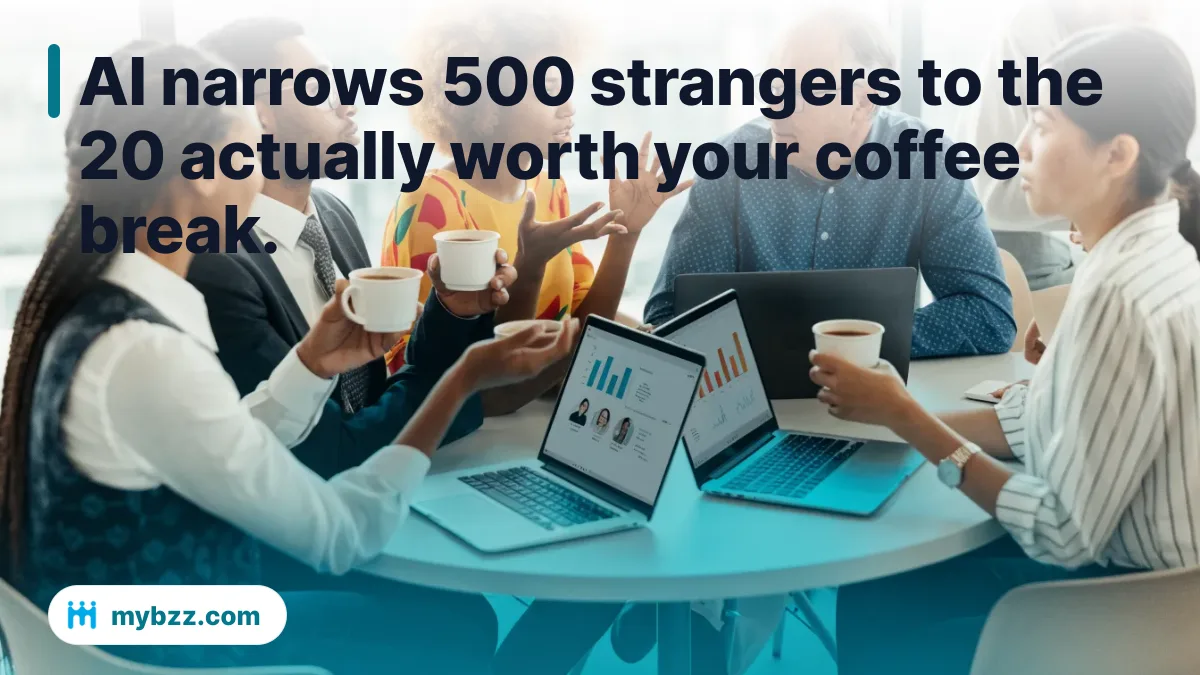
The other strong names are built primarily for people running events. Swapcard powers large conferences and expos, using vector-based models to score 1:1 and small-group pairings inside its event app – if you’re a delegate at a big tech summit, you’ve likely used it without knowing the name.
B2match leans into trade shows and buyer-seller formats, with hosted buyer programs that arrange meetings between purchasers and suppliers before doors open. Converve sits in a similar space, built around structured matchmaking with assigned tables and time blocks.
The common thread: these are organizer tools. You rarely choose them yourself – the conference chooses them for you. They’re excellent inside the event window, but when the expo ends, so does the matchmaking. For an entrepreneur who treats networking as a continuous habit, that’s exactly the gap a platform like ours closes.
Where AI matchmaking still gets it wrong
The sales pages rarely mention the failure modes. The technology is only as good as the profile data feeding it. Fill out two lines and the algorithm has almost nothing to score – you’ll get generic suggestions and blame the tech.
A few real limitations worth planning around:
- Thin profiles poison the results. Vague goals ("open to opportunities") give the algorithm nothing specific to match. Write what you actually want.
- Cold-start problems. New users and events have little behavioral history, so early recommendations lean on self-reported data, which people exaggerate.
- Over-optimization. If everyone chases the same five "high-score" investors, those people drown in requests and reply to no one. A perfect match on paper means nothing if the person never answers.
- Intent drift. You set goals in January, pivot in March, and the algorithm keeps matching you to the old you. Update your profile when things change.
None of this makes the technology useless. It means the human still has to show up prepared. Treat AI as a filter that narrows 500 people to 20, then do the old-fashioned work of writing a good first message and following through. A ranked list is a starting point, not a shortcut past relationship-building.
How to choose the right tool for your goal
The choice comes down to one question: do you need connections for one event, or all the time?
If you’re an individual building a network that outlasts any single event, you want something always-on. That’s where we come in – our breakdown of a business partner matching app and the Mybzz vs lunchclub comparison lay out what each approach does well. The one rule: a tool that matches on real business intent beats one that matches on job title alone.
If you’re organizing a conference, pick an event-app platform – Swapcard, Brella, b2match, or Converve – based on format and size. Trade show with buyers and sellers? b2match’s hosted buyer model earns its keep. Swapcard or Brella handle scheduling cleanly.
FAQ
Is AI matchmaking only useful during live events?
No. Event-app tools like Swapcard or Brella work only during the event window, but platforms built for ongoing networking match you continuously. Our own approach keeps working year-round, so you’re not limited to the two days you hold a conference ticket.
Can I use event matchmaking for free?
Yes, at least partially. Our platform offers a free plan with no time limit, and you can post business offers and browse events without paying. Many organizer-side tools are paid by the event host, so as a delegate you often use them at no personal cost.
What’s the biggest mistake people make with matchmaking apps?
Writing a thin, vague profile. The algorithm can only match what you tell it, so "open to opportunities" produces generic results. Spell out exactly what you want – a co-founder in fintech, a seed investor, a distribution partner in Germany – and the recommendations sharpen immediately.
How is this different from LinkedIn or a general professional network?
Large professional networks are built for broad reach and public posting; AI event matchmaking is built for targeted, goal-based 1:1 connections. Instead of scrolling a feed, you get a ranked list of specific people whose business intent aligns with yours, often with a way to book a meeting directly.
Pick your tool by horizon: event-app platforms for organizers, an always-on matcher if you want the right people reaching you all year. The cheapest way to test the second approach is to set up a detailed profile on Mybzz, post one clear business offer, and see who the matching surfaces this week. Fifteen minutes of profile work, free, no time limit.
Rate this article
Ready to grow your business?
Download MYBZZ for free and join thousands of entrepreneurs.
Download the app for free
Related articles
Local networking apps vs. in-person meetups: which is better?
13.11.2026 · 6 min
How to Find Mentorship Opportunities Through Networking
10.11.2026 · 7 min
Networking strategies for tech entrepreneurs seeking mentorship
09.11.2026 · 8 min