Finding Strategic Partners: Key Warning Signs Online
 Katarzyna Górecka
•
•
10 min read
•
★★★★★5/5 (433 reviews)
Katarzyna Górecka
•
•
10 min read
•
★★★★★5/5 (433 reviews) Recognize early warning signs when finding strategic partners online to avoid costly mistakes. Ensure genuine collaborations by reading our guide.

A wrong strategic partner costs more than no partner at all. Finding strategic partners online means spotting the warning signs before you sign anything, share revenue, or hand over access to your customers. The red flags show up early: vague answers about who they actually work with, pressure to move fast, no verifiable track record, and a "partnership" that only benefits one side. A strategic partnership is a formal or informal alliance between non-competing businesses that share resources, audiences, or capabilities to reach goals neither could hit alone. Many partnerships fail because someone ignored a signal they saw on day one. This guide walks through the warning signs, why they matter, and how to vet a partner before you commit.
Why finding strategic partners online carries real risk
The internet made partnering faster. You can find a co-founder in Berlin, a distributor in Dubai, or an investor in São Paulo without leaving your desk. Speed cuts both ways. The same channels that let you meet the right person also let anyone present a polished version of a business that barely exists.
Here is the core problem. When you meet someone online, you inherit their claims before you inherit any proof. A slick website, a confident pitch deck, and a few testimonials can all be assembled in an afternoon.
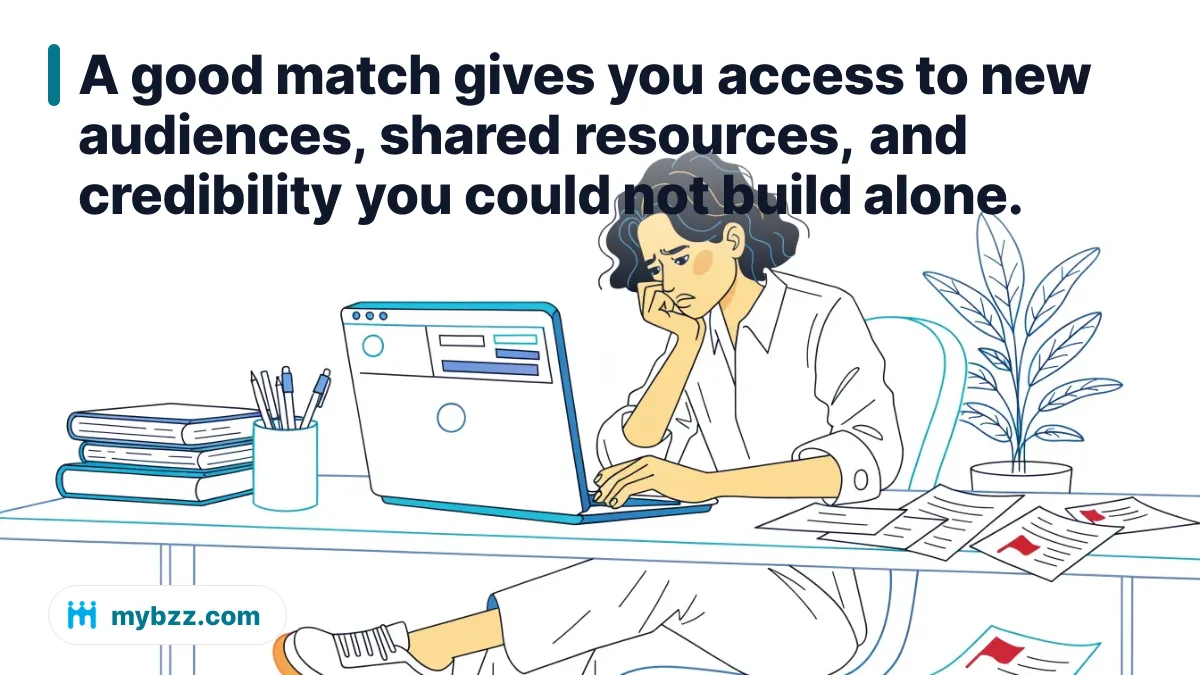
Finding strategic partners online is worth it when done carefully. A good match gives you access to new audiences, shared resources, and credibility you could not build alone. Non-competing businesses form these alliances precisely to spread risk. But the risk only spreads fairly when both sides bring something real. The warning signs below help you separate the person who wants to build with you from the person who wants to use you as a shortcut.
Warning sign 1: they push for speed and skip the details
Urgency is the oldest pressure tactic in business. A potential partner who insists you "lock this in this week" before you have seen their financials, their existing partnerships, or a written agreement is telling you something. Legitimate partners understand a serious alliance needs due diligence on both sides. They expect questions. They welcome them.
Watch for these specific moves:
- They set an artificial deadline with no real reason attached to it
- They resist putting terms in writing until "we’ve built trust"
- They get defensive when you ask about revenue, customers, or past deals
- They want access to your network or clients before contributing anything themselves
The fix is boring and it works. Slow the process down and see how they react. A real partner will match your pace. Someone trying to extract value fast will get frustrated, and that frustration is your answer. Formal partnership agreements exist for exactly this reason, they define who does what, who owns what, and what happens if things fall apart. Anyone who treats a written agreement as an insult is not offering a partnership. They are offering a trap dressed up as an opportunity.
Warning sign 2: no verifiable track record or shared audience
The strongest strategic partnerships happen between businesses with similar audiences but distinct services. A payroll tool partnering with an accounting firm makes sense, both serve small business owners, neither competes with the other. When someone proposes a partnership and you cannot figure out what audience overlap exists, or what complementary strength they bring, stop and ask directly.
Verification matters more online than off. In person, you pick up context, the office, the team, the way they talk about their work. Online, you have to build that context deliberately. Look for a real photo, a filled-out profile, named clients, and a description that actually says what they do. This is a signal of intent. Users on our platform who complete their profile fully, with a real photo, a clear description, and listed skills and experience, get the highest response rates by a wide margin. You are searching for a business partner and you find a one-line bio with no photo. Would you reach out? The same standard you apply to others, apply to anyone approaching you.
Run this quick check before any serious conversation:
- Search their name and company independently, not just the links they send you
- Find at least two existing partners or clients you can identify by name
- Confirm their stated audience actually overlaps with yours
- Ask what they expect to give, not just what they want to get
If you cannot complete steps one through three, you are not evaluating a partner yet. You are evaluating a stranger with a story.
Meet entrepreneurs who think like you
MYBZZ — the networking app for business. Free on iOS & Android.
Warning sign 3: the deal is one-sided from the start
A good strategic partnership rests on shared control, mutual benefit, and clear communication of expectations. When a proposed arrangement fails any of the three, the partnership is broken before it begins.
One-sided deals rarely announce themselves. They arrive disguised as generosity. "I’ll give you access to my whole client list, you just handle all the operations." On paper it sounds like a gift. In practice, one side takes the risk and the work while the other keeps the leverage. Strategic partnerships take many forms, joint ventures, minority equity investments, shared resources, collaborative product development, but every healthy version splits both the upside and the exposure.
Ask yourself three questions before committing:
- What specifically does each side contribute, in writing?
- What does each side walk away with if the partnership ends in six months?
- Who controls the shared asset, the customers, the product, the brand?
A partner who cannot answer these cleanly, or who keeps shifting the answers, is showing you the shape of the deal. Partner ecosystems are projected to drive enormous economic value, and the companies capturing it structure fair terms, not the ones hoping their counterpart never reads the fine print. Credibility and reputation are among the biggest reasons to partner at all. A one-sided deal that blows up publicly damages exactly the reputation you were trying to build.
How to vet a partner before you commit
Vetting is a process, not a gut feeling. The entrepreneurs who avoid bad partnerships treat the early stage like hiring, structured, patient, and unafraid to walk away. Here is a practical sequence that filters out most of the risk.
- Verify identity and history first. Confirm the person and business are real and consistent across independent sources before you discuss anything sensitive.
- Clarify mutual fit. Write down what you need and what they need. If the two lists do not connect logically, there is no partnership, just two people talking past each other.
- Test with something small. A pilot project, a co-hosted webinar, a limited referral arrangement. Small commitments reveal how someone actually operates, whether they deliver, communicate, and honor timelines.
- Put it in writing. Once the pilot works, formalize it. A written agreement covering contributions, ownership, exit terms, and dispute resolution protects both sides equally.
- Review before you scale. Only expand after you have seen real behavior, not just promises.
This is where the right tools save time. At Mybzz, we built AI matching that connects entrepreneurs based on goals, industry, and business intent rather than random outreach, which means the people you meet are already filtered for relevance. It cuts the noise and starts conversations from mutual purpose. For a focused resource on structured matching, our business partner matching app walks through how AI pairs founders and partners across more than 50 countries. Structured matching does not replace vetting, but it means you spend your due diligence energy on genuine prospects instead of tire-kickers.
Where to find strategic partners worth vetting
Not every channel produces the same quality of partner. Here is how the main options compare when your priority is finding strategic partners you can actually trust.
| Channel | Best for | Watch out for |
|---|---|---|
| Mybzz | AI-matched entrepreneurs by intent | Smaller community, quality over volume |
| Large professional networks like LinkedIn | Verification and background checks | High noise, cold outreach, slow to match |
| Industry events and conferences | Face-to-face trust signals | Cost, travel, limited follow-through |
| Startup and funding hubs | Investor and co-founder searches | Crowded, hard to stand out |
| Warm referrals | Pre-vetted trust from a mutual contact | Limited reach, depends on your network |
Our platform is built exclusively for entrepreneurs, which sets it apart from general networks where you fish through recruiters, job seekers, and sales pitches to find a partner. On Mybzz.com, posting a business offer is free, offers go live immediately, and new ones appear daily, covering B2B partnerships, co-founder searches, and projects seeking funding. Entrepreneurs from Poland and abroad use it, and the free plan has no time limit, so you can explore before paying anything.
A practical combination works well. Use Mybzz.com to meet the right people through AI matching, then use a large professional network to verify their background independently. One starts the connection, the other confirms it. Relying on only one leaves a gap, and gaps are where bad partnerships slip through.
FAQ
How do I check if a potential partner online is legitimate?
Search their name and company through independent sources, not only the links they provide. Confirm at least two existing partners or clients you can identify by name, verify their audience actually overlaps with yours, and check that their online profile is complete with a real photo and clear description. If you cannot verify these basics, treat every claim as unconfirmed.
What is the biggest red flag when finding strategic partners?
Pressure to move fast while avoiding written terms. A legitimate partner expects due diligence and welcomes questions about revenue, customers, and past deals. Someone who sets artificial deadlines, resists putting anything in writing, or gets defensive under scrutiny is usually protecting something. Slow the process down and watch how they react.
Should I sign a written agreement even for a small partnership?
Yes. A formal agreement defines contributions, ownership, exit terms, and what happens if the arrangement ends. Even a lightweight pilot benefits from clear written expectations. Anyone who treats a written agreement as a sign of distrust is telling you they prefer ambiguity, which almost always favors them over you.
Can AI matching help me avoid bad partners?
AI matching filters for relevance by pairing entrepreneurs on goals, industry, and intent, so you spend less time on mismatched prospects. It reduces noise and starts conversations from mutual purpose. It does not replace due diligence, though. You still verify identity, confirm mutual fit, and test with a small project before committing to anything larger.
The difference between a partnership that grows your business and one that drains it usually comes down to whether you paused when the warning signs appeared. Speed pressure, missing track records, and one-sided terms are not minor annoyances, they are the deal telling you what it really is. Run the checks, start small, and put terms in writing before you scale. If you want to meet entrepreneurs who are already filtered for relevance and serious about building, create a free profile on Mybzz.com and post your first offer today. Meeting the right people is faster when the matching does the heavy lifting, and your only job is to vet well.
Rate this article
5/5 (433 reviews)
Ready to grow your business?
Download MYBZZ for free and join thousands of entrepreneurs.
Download the app for free

Related articles
What is the best way to find business partners? A framework that outperforms traditional messaging
10.09.2026 · 8 min
What should you ask a potential business partner: 7 key questions
06.09.2026 · 8 min
Finding the best business collaboration opportunities
16.08.2026 · 12 min