Incubator Networking Best Practices: Success in Startups
 Katarzyna Górecka
•
•
7 min read
Master incubator networking best practices to drive startup success. Discover strategies for building valuable connections in your entrepreneurial journey.
That’s the mistake. The best incubator networking practices turn your cohort, mentors, and alumni into your fastest path to funding, customers, and co-founders.
This guide breaks down the practices that actually move the needle: how to approach peers, mentors, and investors strategically instead of hoping luck does the work. We also cover the tools that extend your network beyond the building, because the smartest founders don’t stop networking when the program ends.
Why Networking Inside an Incubator Beats Networking Anywhere Else
An incubator gives early-stage startups workspace, mentorship, training, and a community of founders during the foundational phase of building a company. The networking advantage is baked into the model. Everyone in the building shares the same context – raising money, hiring, finding product-market fit – so conversations skip the small talk and land on real problems fast.
Three numbers explain why this environment rewards strong relationships. Graduates of top programs raise far more money, partly because warm introductions from mentors and alumni carry weight investors trust.
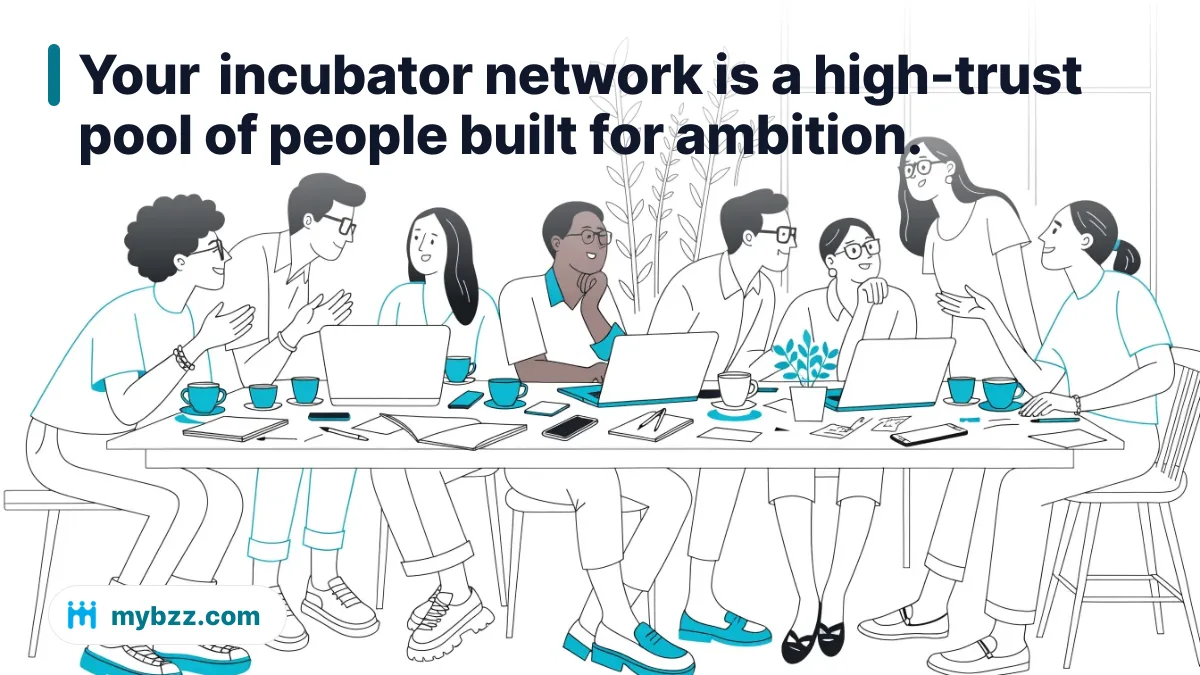
The takeaway: your incubator network is a closed, high-trust pool of people pre-selected for ambition. Few other settings concentrate that many motivated builders in one place. Treat the relationships as a core asset, not a bonus.
The Core Incubator Networking Best Practices Founders Overlook
Most founders network reactively. They talk to whoever sits next to them and hope something sticks. The founders who get the most out of a program work from a short, deliberate playbook:
- Map your cohort in the first week. Write down who’s building what, who has skills you lack, and who serves a customer base adjacent to yours. You can’t build strategic relationships with people you haven’t categorized.
- Lead with help, not asks. Offer an intro, a tool recommendation, or a quick review before you ever request anything. Reciprocity compounds over months.
- Turn hallway chats into scheduled 1:1s. A 25-minute coffee digging into one specific challenge beats five vague "we should connect" moments.
- Prepare mentors in advance. Send a two-line context note before every mentor session so the hour goes to problem-solving, not catch-up.
- Document every introduction. Track who connected you to whom, so you can return the favor and keep the loop alive after demo day.
One thing separates good networkers from great ones: consistency of follow-through. The relationship you build in week two means nothing if you go quiet in week ten. Short, specific check-ins keep you top of mind when a mentor hears about an opening or an investor asks who’s worth meeting.
Meet entrepreneurs who think like you
MYBZZ — the networking app for business. Free on iOS & Android.
How to Turn Mentor and Alumni Relationships Into Real Opportunities
Mentors and alumni are the two most underused parts of any incubator network. Mentors give you access to their judgment and their rolodex. Alumni provide a playbook that already worked – they survived the exact stage you’re in now.
With mentors, specificity wins. Don’t ask "any advice on growth?" Ask "here are my two acquisition channels and their cost per customer – which should I kill?" Mentors respond to founders who come with data and a decision to make. That’s how a casual advisor becomes someone who later writes you a check or makes a warm introduction to one who will.
Alumni networks pay off differently. A founder who graduated two years ago has already pitched the investors you’re about to pitch. A single conversation can save you a month of trial and error. List the alumni whose companies rhyme with yours, and ask program staff for introductions.
A realistic sequence that works inside most programs:
- Identify the three mentors whose background matches your next milestone.
- Book recurring sessions rather than one-offs – momentum beats novelty.
- After each session, send a short note on what you’ll change and report back next time.
- Ask each mentor for one alumni introduction relevant to your current problem.
- Keep a running thank-you habit – update people when their advice produced a result.
Founders who treat mentorship as a two-way relationship, not a free consulting hour, are the ones mentors champion long after the program ends.
Extending Your Network Beyond the Incubator Walls
An incubator cohort usually runs a few months and holds maybe a few dozen founders. Powerful, but finite. The founders who keep growing after demo day plug the incubator into a wider global network – and that’s where the right tools matter.
Our platform, Mybzz, was built for exactly this gap. Mybzz is a business networking app that uses AI to match entrepreneurs, founders, and investors by business intent and goals – not by how many connections you can rack up. You create a full business profile, browse other entrepreneurs, and the matching surfaces people whose objectives line up with yours.
That’s how matching stays tuned to what founders actually need.
If you’re comparing options, see our rundown of the business networking apps worth testing in 2026, our shapr alternative guide for founders who want swipe-style matching done better, and a breakdown of linkedin alternatives for entrepreneurs who’ve outgrown generic feeds.
Mybzz vs Shapr: Choosing the Right Networking App for Founders
Founders leaving an incubator often weigh swipe-based apps against intent-based matching. Both aim to connect you with the right people but get there differently. For a deeper look, our Mybzz vs shapr comparison covers it in full – here’s the short version.
| Factor | Mybzz | Swipe-style networking apps |
|---|---|---|
| Matching basis | AI matching by business goals and intent | Mostly location and quick swipe signals |
| Conversation style | Focused 1:1 chats | Casual connect-and-message |
| Platforms | iOS, Android, and web | Typically mobile-first |
| Free access | Free plan with no time limit | Varies by app |
| Built-in offers | Post B2B, co-founder, and investment offers | Usually not included |
| Events | 7,286+ listed worldwide | Limited or none |
The practical difference: intent-based matching puts you in front of people whose goals overlap with yours, which matters when your time outside the incubator is tight. For a founder hunting a technical co-founder or a specific investor, matching by business intent beats scrolling through a geographic feed hoping for overlap.
FAQ
What is the single most effective incubator networking practice?
Scheduling specific, recurring 1:1 conversations instead of relying on random hallway encounters. A 25-minute meeting focused on one real challenge builds more trust and surfaces more opportunities than a dozen vague "let’s connect" moments. Pair that with consistent follow-up and you stay top of mind when a mentor or peer hears about an opening.
How do I network with investors inside an incubator without being pushy?
Lead with progress, not asks. Share a short update on a milestone you hit, invite feedback, and let the investor pull the conversation toward funding on their own terms.
Do I still need networking apps if my incubator has a strong community?
Yes. A cohort is finite – usually a few dozen founders over a few months. Apps like Mybzz extend your reach to entrepreneurs and investors worldwide, matched by business intent, so you keep building relationships long after demo day. The free plan has no time limit, which makes it easy to run alongside your program.
How soon should I start networking after joining an incubator?
In week one. Map your cohort immediately – who’s building what, who has skills you lack, who serves adjacent customers. Early relationships compound over the length of the program, and founders who start fast are the ones mentors and peers remember when opportunities appear.
The founders who get the most out of an incubator treat every relationship as a long game: help first, follow up specifically, and keep the network alive after the program ends. Start by mapping your cohort this week and booking two recurring mentor sessions. Then extend that momentum beyond the building – create a free Mybzz profile, post an offer, and let AI matching put you in front of the partners and investors who actually fit your goals. The relationships you build now are the ones that fund your next round.
Rate this article
Ready to grow your business?
Download MYBZZ for free and join thousands of entrepreneurs.
Download the app for free

Related articles
Understanding Networking as a Tool for Startup Incubators
28.10.2026 · 8 min
Guide to Mentorship Networking for Startups
25.10.2026 · 9 min
Networking for Startup Funding Success: Steps to Secure Capital
24.10.2026 · 7 min