Guide to Networking for Tech Entrepreneurs Seeking Co-Founders
 Katarzyna Górecka
•
•
7 min read
Katarzyna Górecka
•
•
7 min read
Struggling to find a non-tech co-founder? Learn practical networking for tech entrepreneurs to bridge the skills gap effectively. Read more in our guide.
The best startup teams rarely come from the same background. A technical founder who can build anything still needs someone to sell it, manage the money, and keep clients happy. Networking for tech entrepreneurs often means stepping outside your own circle to find a non-tech co-founder who covers your blind spots. If you can write production code but freeze when it’s time to pitch an investor, you don’t need another engineer. You need a partner who thinks in markets, deals, and people. This guide covers where to meet those people, how to vet them, and which platforms speed up the search.
Why Tech Founders Need Non-Tech Co-Founders
A non-tech co-founder leads the parts of a startup that don’t involve writing code: sales, operations, finance, legal, hiring, and customer relationships. Plenty of technical founders underestimate how much of a company runs on these functions until revenue stalls.
Here’s the pattern that shows up again and again: two engineers build a polished product nobody buys, because nobody on the team knows how to reach buyers. The fix isn’t a better feature. It’s a co-founder who understands go-to-market.
A strong non-tech partner usually brings one or more of these:
- Commercial instinct – knowing which customers to chase and what they’ll pay
- Fundraising fluency – speaking the language investors use to evaluate teams
- Operational discipline – turning chaos into repeatable systems as you scale
- Relationship building – closing partnerships and keeping key accounts warm
Emotional intelligence matters more than most engineers expect. A co-founder who reads a room, defuses tension with a client, and negotiates calmly does work no amount of clean code replaces. That complementary skill set often separates a startup that stalls from one that compounds.
Where to Find Non-Tech Co-Founders
The hardest part of networking for tech entrepreneurs is meeting people outside your own discipline. Engineers tend to network with engineers, and breaking that loop takes intention.
Start with the channels where business-minded people gather:
- Startup co-founder matching events – in-person meetups built to pair technical and non-technical founders. Many cities run regular sessions where people pitch themselves and swap contacts on the spot.
- Accelerator and incubator alumni networks – full of operators and commercial founders looking for a technical partner.
- Industry conferences outside tech – if you’re building for healthcare, finance, or logistics, the person who understands that market is in a room you wouldn’t normally enter.
- AI-driven networking platforms – apps that match you by goals and intent rather than job title, which is how you find a sales leader who wants a product partner.
Collaborative networking events are useful because they’re low-pressure. Everyone is there for the same reason, so you skip the awkward pitch and get straight to "what are you working on."
The weak-ties principle applies too. Your closest contacts already share your worldview. The co-founder you need often comes two or three introductions away, through someone you barely know.
Meet entrepreneurs who think like you
MYBZZ — the networking app for business. Free on iOS & Android.
Using Networking Platforms to Match With Co-Founders
Digital platforms have changed co-founder matchmaking. Instead of hoping the right person wanders into a meetup, you can filter by what you’re looking for and let an algorithm surface candidates. Here’s a comparison of options tech founders actually use.
| Platform | Built for | How matching works | Access |
|---|---|---|---|
| Mybzz | Entrepreneurs seeking partners, co-founders, investors | AI matches by goals, experience, and business intent | Free plan plus VIP Lifetime Access (one-time, web only) |
| Broad professional networking | Search and manual outreach | Free plus paid tiers | |
| Niche founder forums | Startup founders by stage or industry | Community threads and intro requests | Usually free |
Our app, Mybzz, was built exclusively for entrepreneurs, which is why the matches feel different. The AI analyzes profiles, industries, and goals, then pairs people whose intent overlaps. A technical founder looking for a commercial partner gets matched with operators who want exactly that, so conversations start from mutual interest, not a cold message. To compare approaches first, our Mybzz vs bumble bizz breakdown shows how a founder-first tool stacks up against broader social apps, and our Mybzz vs entre perspective covers where each fits best.
How to Vet a Non-Tech Co-Founder Before Committing
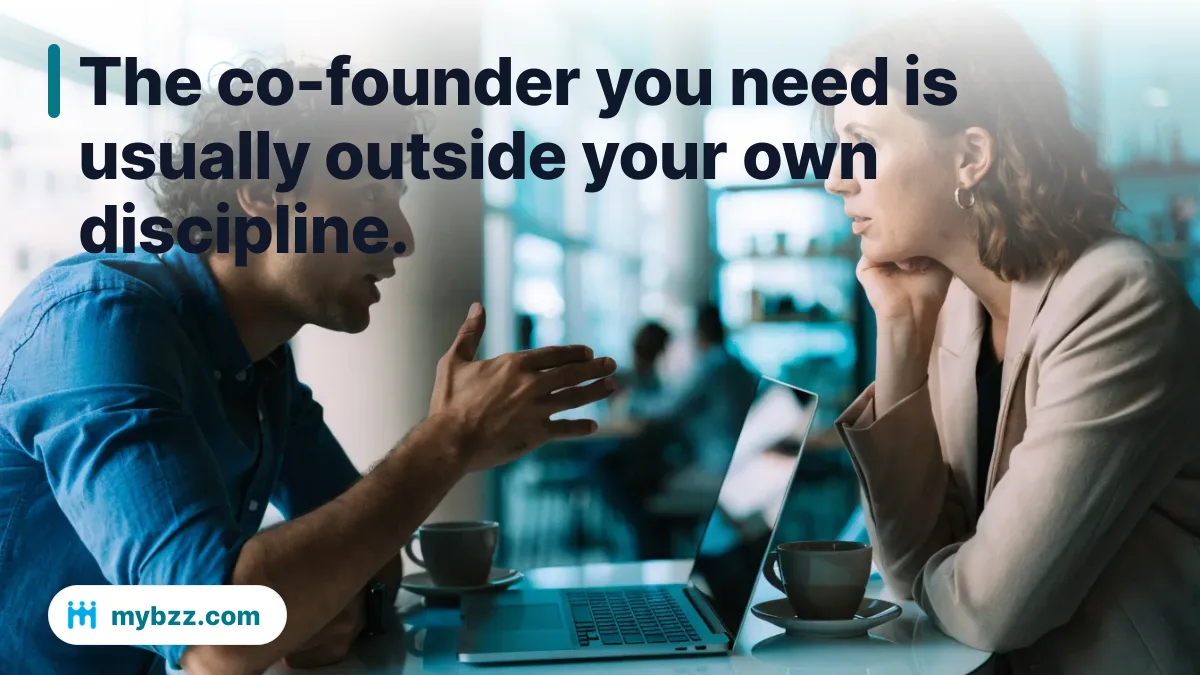
Meeting someone is easy. Choosing a co-founder is where most founders get it wrong. A bad match costs you years, not weeks, so vet hard before you split equity.
Run through these before any commitment:
- Values and work ethic – do you agree on how hard, how fast, and how honest you both operate?
- Complementary strengths – they should cover what you can’t, not duplicate what you do well
- Conflict style – watch how they handle disagreement in a low-stakes situation first
- Track record – ask for specific results, not titles. "I grew revenue from X to Y" beats "VP of Sales"
- Commitment reality – are they ready to go full-time, or is this a side interest?
The smartest move is a trial project before equity. Work together on a small, real task for a month: a sales push, a fundraising deck, a partnership pitch. You learn more from one shared deadline than from ten coffee chats. Pay attention to how they communicate when something goes wrong – that’s the version of them you’ll live with during the hard quarters.
Building a Relationship That Survives the Startup
Finding strategic partners is step one. Keeping the partnership intact through growth and setbacks is the real work. Co-founder breakups kill more startups than competition does.
Three habits keep a founding relationship healthy:
- Define roles in writing early – who owns product, who owns revenue, who has the final call when you disagree.
- Set an equity split and vesting schedule – protect both of you if someone leaves. Vesting isn’t distrust; it’s insurance for the company.
- Schedule a recurring founder check-in – a weekly or biweekly honest conversation about what’s working and what isn’t.
The best co-founder pairs treat their partnership like an ongoing deal they both keep investing in. When one of you brings bad news, bring it early and directly – the same discipline that keeps investor relationships strong keeps co-founder trust strong. A non-tech partner who respects your technical judgment, paired with a technical founder who trusts their partner’s commercial read, is a combination investors notice and fund.
FAQ
Where can tech entrepreneurs meet non-tech co-founders?
Co-founder matching events, accelerator alumni networks, industry conferences outside tech, and AI-driven networking platforms are the most reliable channels. Platforms like Mybzz match entrepreneurs by goals and business intent across more than 50 countries, so a technical founder can surface commercial partners without scrolling through irrelevant profiles. In-person collaborative networking events work well for low-pressure first conversations.
How much does it cost to use a networking app like Mybzz?
Mybzz offers a free plan with no time limit, which lets you explore and connect without paying. For advanced search and global connections, there’s a VIP Lifetime Access option as a one-time payment on the web version, plus monthly subscriptions through the App Store and Google Play. Start for free and upgrade only if you want wider reach.
Should co-founders split equity equally?
Not automatically. Equity should reflect contribution, risk, and commitment rather than a default 50/50. The safer approach is agreeing on a split tied to roles and adding a vesting schedule, so equity is earned over time and the company is protected if someone leaves early. Put it in writing before you start building together.
If your product is solid but your team is missing a commercial half, stop searching alone. Create a profile on Mybzz, set your goal to "finding a co-founder," and let the AI matching surface operators who want exactly the technical partner you are. You can also browse our guide on the 8 best business networking options and read our shapr alternative comparison to see where each tool fits. The right co-founder is out there – you just have to look outside your own discipline to find them.
Rate this article
Ready to grow your business?
Download MYBZZ for free and join thousands of entrepreneurs.
Download the app for free
Related articles
Guide to Web-Based Networking for Businesses and Its Benefits
30.09.2026 · 7 min
AI’s Impact on Professional Networking Application Evolution
29.09.2026 · 8 min
Top networking apps for professionals in India: 5 picks
28.09.2026 · 8 min