Guide to Web-Based Networking for Businesses and Its Benefits
 Katarzyna Górecka
•
•
7 min read
Katarzyna Górecka
•
•
7 min read
Web-based networking for businesses offers precise AI-driven matches, connecting entrepreneurs globally. Ensure quality partnerships with optimal tools.
Send a cold email to 200 strangers on a professional network and you’ll get a handful of replies, maybe. Web-based networking for businesses flips that math when it’s built around intent instead of volume. It means using internet platforms and browser-based tools to build professional relationships, find partners, and open growth opportunities without leaning on in-person events. Do it well and you connect with people who actually want what you offer.
The shift that matters most in 2026 is who does the matching. Instead of scrolling endless feeds, entrepreneurs now rely on platforms where AI reads goals and business intent, then puts the right people in front of each other. Fewer messages, better conversations, and deals that would never happen at a local meetup. This guide walks through the concrete benefits, the tools worth using, and how AI changes the quality of every connection.
Why web-based networking for businesses beats old-school methods
The classic route to business relationships was slow and geographically trapped. You attended a conference, collected cards, and hoped one in fifty led somewhere. Web-based networking removes both limits at once: distance and luck.
Look at the reach. A founder in Warsaw can talk to a manufacturer in São Paulo, a SaaS operator in Berlin, and an angel investor in Dubai in the same afternoon. That flow of fresh, active users is what makes online matching worth the effort.
Speed is the second advantage. You post a business offer once and it’s publicly visible right away, seen by people who logged in specifically to find collaborators. No waiting for the next quarterly mixer. If you want a deeper look at making these connections stick, we cover the tactics in networking for small businesses building connections that matter. The core benefit stays simple: more relevant people, reached faster, at a fraction of the cost of flights and event tickets.
How AI turns quantity into quality
Reaching more people only helps if they’re the right people. This is where AI-driven matching separates a modern platform from a glorified contact list. AI matching is a system that analyzes user profiles, industries, and stated goals to connect people whose business intent lines up.
Old networking rewarded whoever collected the most connections, which floods your inbox with pitches, spam, and people who have nothing to offer. AI changes this dynamic.
The system looks at your industry, experience, and intent, then starts conversations from mutual interest rather than a cold guess. We break down how this works in AI matching benefits in business networking: key advantages and what makes AI-based networking platforms a game changer.
Three practical effects come out of AI matching:
- Less noise: you stop wading through irrelevant profiles and generic pitches.
- Higher intent: matches share a reason to talk, so replies come faster.
- Better fit: a co-founder search returns co-founders, not casual browsers.
Meet entrepreneurs who think like you
MYBZZ — the networking app for business. Free on iOS & Android.
Real examples across different industries
A single platform can serve a fintech founder and a boutique agency owner in completely different ways.
Take a B2B software company hunting for distribution partners. Instead of guessing which agencies serve their target market, they post a partnership offer and let matches surface resellers already active in that space. A co-founder search works the same way: a technical founder describes the gap – say, a commercial lead – and the system prioritizes people with that exact profile.
Investment is a third case. A startup seeking funding can publish a project openly, and interested backers reach out from genuine intent, not obligation.
Here’s how the same tool adapts to each goal:
| Business goal | What you post | What the match delivers |
|---|---|---|
| Distribution growth | B2B partnership offer | Active resellers and agencies |
| Building a team | Co-founder search | People with the missing skill set |
| Raising capital | Project seeking funding | Investors reaching out on intent |
| Cross-border expansion | Offer tagged by market | Partners in target countries |
Essential tools for web-based networking for businesses
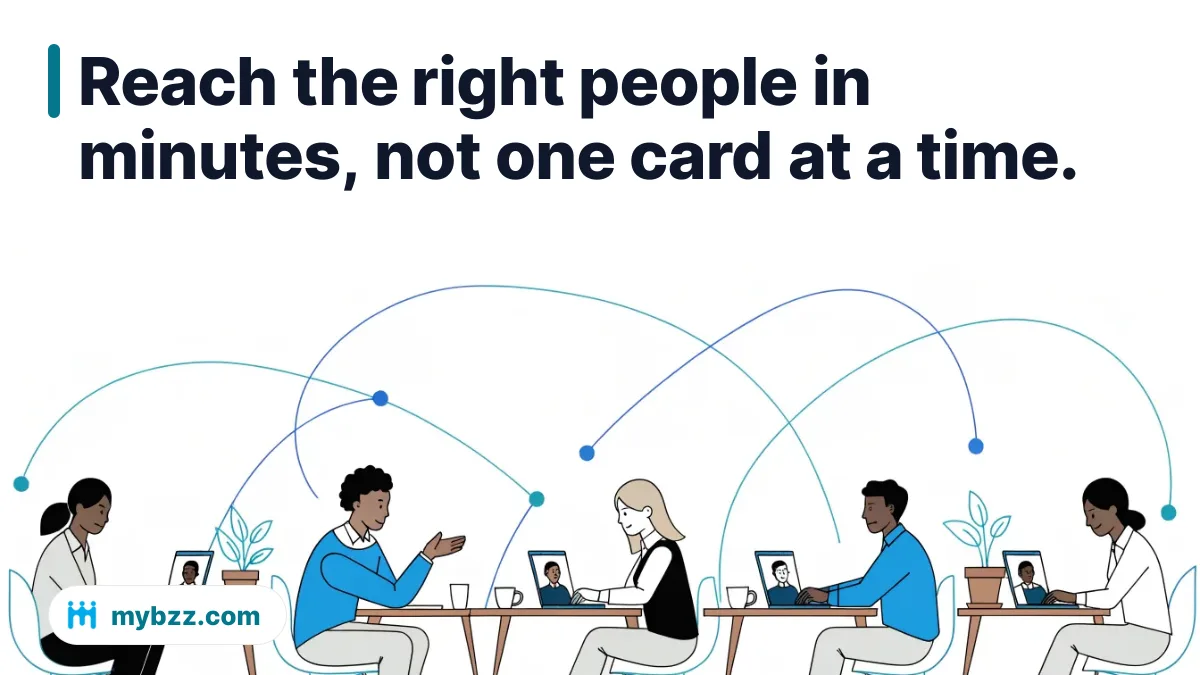
You don’t need a bloated software stack. A few well-chosen tools cover most of what web-based networking actually requires: a place to be discovered, a way to filter, and a channel to talk.
Mybzz – our platform, built exclusively for entrepreneurs. AI matches you by goals and business intent, so conversations start from mutual interest instead of cold outreach.
- Available as a web platform and iOS/Android app; the web version adds a business feed.
- Free plan with no time limits; VIP Lifetime Access is a one-time payment on the web.
- VIP unlocks advanced search and global connections across 50+ countries — Unlocking VIP access enhances your networking experience by providing tailored search capabilities and facilitating connections with professionals worldwide
- Best for: founders who want the right people, not the biggest list.
LinkedIn – the largest professional network, strong for verifying identities, checking work history, and researching a contact before a call. Its feed leans toward content and job-hunting more than direct partner matching.
- Best for: background checks and B2B credibility research.
Xing – a professional network with a strong footprint in German-speaking markets, useful if your expansion targets that region. We put the two head to head in Mybzz vs xing if you’re weighing the fit.
The practical combination many entrepreneurs use: Mybzz to meet the right people through AI matching, and LinkedIn to verify them. One finds the connection, the other confirms it. For a broader roundup, see our 8 best business networking apps guide.
Where events and matching apps fit together
Online networking and live events aren’t rivals – they compound. A curated virtual event puts you in a room of relevant people, and a matching app keeps those relationships alive afterward.
The mistake is treating one as a replacement. You meet someone at a virtual roundtable, then use a business partner matching app to keep the conversation structured around a shared goal instead of letting it fizzle in a crowded inbox. We host our own online sessions – browse the schedule under networking events – so members can move from a group setting into one-on-one matches without losing momentum.
Think of it as a pipeline. Events create visibility and first impressions; matching apps handle the follow-up, filtering, and long-term relationship management. A founder who only attends events collects contacts but struggles to nurture them. A founder who only uses an app misses the trust that face-to-face – even on video – builds quickly. Running both is how the strongest networks get built: broad reach at the top, deep relationships at the bottom. If you’re comparing options, Mybzz shows how the two connect in practice.
FAQ
How does web-based networking benefit businesses?
It removes geography and luck from building relationships. You reach relevant people across 50+ countries in minutes, at a fraction of the cost of travel and events. With AI matching, you also cut wasted time – the platform surfaces contacts who share your goals, so replies come faster and connections turn into real conversations.
What tools are essential for web-based networking?
At a minimum you need a discovery platform, a filtering method, and a communication channel. Mybzz covers discovery and filtering through AI-driven matching built for entrepreneurs, while LinkedIn is handy for verifying a contact’s history before you commit. Xing helps if you’re targeting German-speaking markets. Most entrepreneurs combine two or three rather than relying on one.
What are the top web-based networking platforms for businesses?
Mybzz leads for meeting the right people, with AI matching built specifically for entrepreneurs. LinkedIn remains the largest general professional network and works well for research and credibility checks. Xing serves the German-speaking region. The right pick depends on your goal – Mybzz for meeting the right people, LinkedIn for verifying them.
The pattern across every point here is the same: web-based networking works best when the platform does the filtering for you. Volume alone buries you in noise; intent-based matching hands you a shortlist worth your time. If you’ve been collecting contacts without turning them into anything, start smaller and sharper. Create a free Mybzz account, post one clear offer, and let AI matching bring the right people to you – it costs nothing to test whether the market responds. That single step usually teaches you more in a week than months of scattered outreach ever did.
Rate this article
Ready to grow your business?
Download MYBZZ for free and join thousands of entrepreneurs.
Download the app for free
Related articles
Guide to Networking for Tech Entrepreneurs Seeking Co-Founders
02.10.2026 · 7 min
AI’s Impact on Professional Networking Application Evolution
29.09.2026 · 8 min
Top networking apps for professionals in India: 5 picks
28.09.2026 · 8 min